
SenseVoicecpp ggml-cann.cpp大模型[AI人工智能(七十六)]—东方仙盟
我们坚信,每一份原创智慧都值得被尊重与回馈,以永久分成锚定共创初心,让创意者长期享有价值红利,携手万千伙伴向着科技星辰大海笃定前行,拥抱硅基生命与数字智能交融的未来,共筑跨越时代的数字文明共同体。在智能时代的浪潮里,单打独斗的发展模式早已落幕,唯有开放连接、创意共创、利益共享,才能让个体价值汇聚成生态合力,让技术与创意双向奔赴,实现平台与伙伴的快速成长、共赢致远。,负责把 ggml 的张量计算指令
ggml-cann.cpp
核心代码
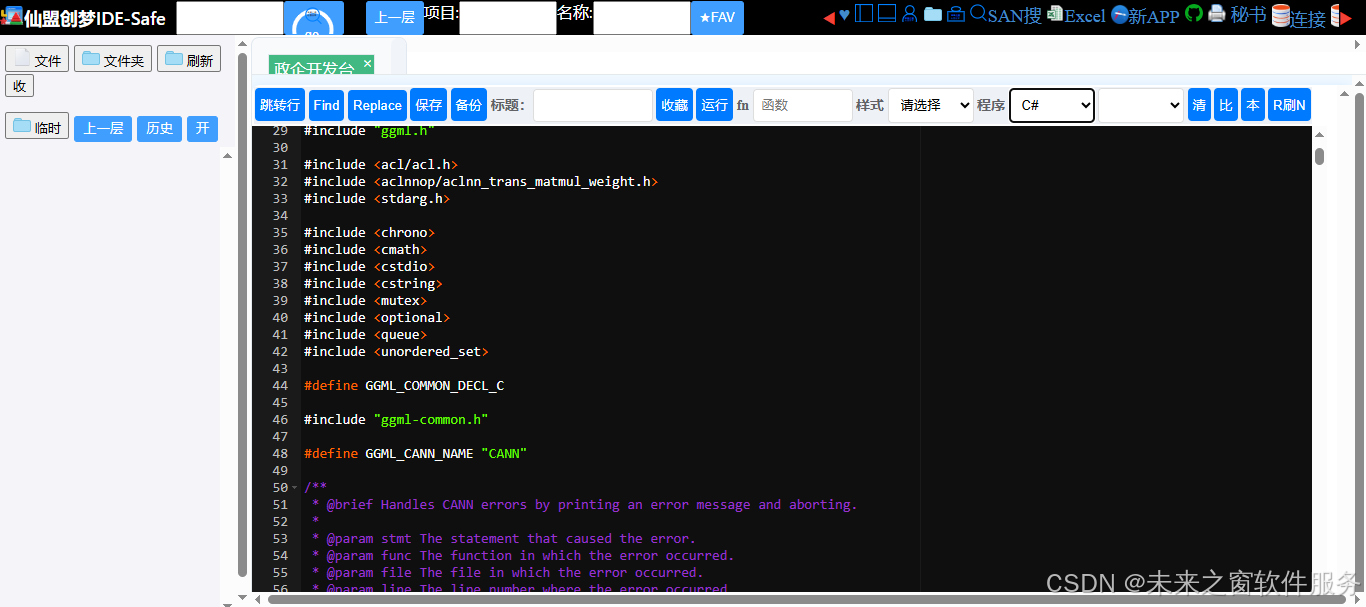
完整代码
/*
* Copyright (c) 2023-2026 The ggml authors
*
* Permission is hereby granted, free of charge, to any person obtaining a copy
* of this software and associated documentation files (the "Software"), to
* deal in the Software without restriction, including without limitation the
* rights to use, copy, modify, merge, publish, distribute, sublicense, and/or
* sell copies of the Software, and to permit persons to whom the Software is
* furnished to do so, subject to the following conditions:
*
* The above copyright notice and this permission notice shall be included in
* all copies or substantial portions of the Software.
*
* THE SOFTWARE IS PROVIDED "AS IS", WITHOUT WARRANTY OF ANY KIND, EXPRESS OR
* IMPLIED, INCLUDING BUT NOT LIMITED TO THE WARRANTIES OF MERCHANTABILITY,
* FITNESS FOR A PARTICULAR PURPOSE AND NONINFRINGEMENT. IN NO EVENT SHALL THE
* AUTHORS OR COPYRIGHT HOLDERS BE LIABLE FOR ANY CLAIM, DAMAGES OR OTHER
* LIABILITY, WHETHER IN AN ACTION OF CONTRACT, TORT OR OTHERWISE, ARISING
* FROM, OUT OF OR IN CONNECTION WITH THE SOFTWARE OR THE USE OR OTHER DEALINGS
* IN THE SOFTWARE.
*/
#include "ggml-cann.h"
#include "ggml-backend-impl.h"
#include "ggml-cann/aclnn_ops.h"
#include "ggml-cann/common.h"
#include "ggml-impl.h"
#include "ggml.h"
#include <acl/acl.h>
#include <aclnnop/aclnn_trans_matmul_weight.h>
#include <stdarg.h>
#include <chrono>
#include <cmath>
#include <cstdio>
#include <cstring>
#include <mutex>
#include <optional>
#include <queue>
#include <unordered_set>
#define GGML_COMMON_DECL_C
#include "ggml-common.h"
#define GGML_CANN_NAME "CANN"
/**
* @brief Handles CANN errors by printing an error message and aborting.
*
* @param stmt The statement that caused the error.
* @param func The function in which the error occurred.
* @param file The file in which the error occurred.
* @param line The line number where the error occurred.
* @param msg The error message.
*/
[[noreturn]] void ggml_cann_error(const char * stmt, const char * func, const char * file, int line, const char * msg) {
int32_t id = -1;
aclrtGetDevice(&id);
GGML_LOG_ERROR("CANN error: %s\n", msg);
GGML_LOG_ERROR(" current device: %d, in function %s at %s:%d\n", id, func, file, line);
GGML_LOG_ERROR(" %s\n", stmt);
// abort with GGML_ASSERT to get a stack trace
GGML_ABORT("CANN error");
}
// Thread-local variable to record the current device of this thread.
thread_local int g_current_cann_device = -1;
/**
* @brief Set the CANN device to be used.
*
* @param device The target device ID to set.
*/
void ggml_cann_set_device(const int32_t device) {
// int current_device = -1;
// Note: In some CANN versions, if no device has been set yet,
// aclrtGetDevice(¤t_device) may return 0 by default.
// aclrtGetDevice(¤t_device);
// If the current device is already the target one, no need to switch.
if (device == g_current_cann_device) {
return;
}
// Switch to the new device.
ACL_CHECK(aclrtSetDevice(device));
// Update the global device record.
g_current_cann_device = device;
}
/**
* @brief Get the value of the specified environment variable (name) as lowercase.
* if not empty, return a std::string object
*/
std::optional<std::string> get_env_as_lowercase(const std::string & name) {
const char * val = std::getenv(name.c_str());
if (!val) {
return std::nullopt;
}
std::string res = std::string(val);
std::transform(res.begin(), res.end(), res.begin(), ::tolower);
return res;
}
/**
* @brief Verify whether the environment variable is a valid value.
*/
bool parse_bool(const std::string & value) {
static const std::unordered_set<std::string> valid_values = { "on", "1", "yes", "y", "enable", "true" };
return valid_values.find(value) != valid_values.end();
}
/**
* @brief Parse a string as an integer, returning 0 if invalid.
*
* This function attempts to convert the input string `value` to an `int`.
* If the string is not a valid integer or is out of the `int` range,
* it returns 0.
*
* @param value The string to parse.
* @return The parsed integer, or 0 if conversion fails.
*/
int parse_integer(const std::string & value) {
try {
return std::stoi(value);
} catch (...) {
return 0;
}
}
/**
* @brief Initialize the CANN device information.
*
* This function initializes the CANN device information by obtaining the
* device count and setting the memory allocation granularity for each device.
*
* @return A structure containing the device information.
*/
static ggml_cann_device_info ggml_cann_init() {
ggml_cann_device_info info = {};
aclError err = aclrtGetDeviceCount((uint32_t *) &info.device_count);
if (err != ACL_SUCCESS) {
GGML_LOG_ERROR("%s: failed to initialize CANN: %s\n", __func__, aclGetRecentErrMsg());
return info;
}
GGML_ASSERT(info.device_count <= GGML_CANN_MAX_DEVICES);
for (int id = 0; id < info.device_count; ++id) {
aclrtPhysicalMemProp prop = {};
prop.handleType = ACL_MEM_HANDLE_TYPE_NONE;
prop.allocationType = ACL_MEM_ALLOCATION_TYPE_PINNED;
prop.memAttr = ACL_HBM_MEM_HUGE;
prop.location.type = ACL_MEM_LOCATION_TYPE_DEVICE;
prop.location.id = id;
prop.reserve = 0;
err = aclrtMemGetAllocationGranularity(&prop, ACL_RT_MEM_ALLOC_GRANULARITY_RECOMMENDED,
&info.devices[id].vmm_granularity);
info.devices[id].vmm = err == ACL_SUCCESS;
size_t free, total;
ggml_backend_cann_get_device_memory(id, &free, &total);
info.devices[id].total_vram = free;
}
// TODO: add more device info later.
return info;
}
/**
* @brief Retrieve the CANN device information.
*
* This function returns a reference to a structure containing the CANN device
* information. The device information is initialized once and reused on
* subsequent calls.
*
* @return A reference to the structure containing the device information.
*/
const ggml_cann_device_info & ggml_cann_info() {
static ggml_cann_device_info info = ggml_cann_init();
return info;
}
//#define DEBUG_CANN_MALLOC
/**
* @brief A pool of CANN buffers(priority segment buffer).
*
* This class manages a pool of CANN buffers for a specific device.
*/
struct ggml_cann_pool_buf_prio : public ggml_cann_pool {
/**
* @brief The maximum reuse margin for a buffer.
*/
static const size_t max_reuse_margin = 1ull << 22; // 4MB
/**
* @brief The minimum free margin for a buffer.
*/
static const size_t min_free_margin = 1ull << 20; // 1MB
/**
* @brief The alignment for buffer allocation.
*/
static const size_t alignment = 128;
/**
* @brief The device ID associated with this buffer pool.
*/
int device;
/**
* @brief Whether to disable clean during buffer allocation.
*/
bool disable_clean = false;
/**
* @brief Structure representing a CANN buffer.
*/
struct ggml_cann_buffer {
void * ptr = nullptr; ///< Pointer to the buffer.
size_t size = 0; ///< Size of the buffer.
std::chrono::steady_clock::time_point last_used; ///< Last used time.
bool operator>(const ggml_cann_buffer & other) const { return size > other.size; }
};
/**
* @brief Array of CANN buffers in the pool.
*/
std::unordered_map<void *, size_t> buffer_pool;
std::priority_queue<ggml_cann_buffer, std::vector<ggml_cann_buffer>, std::greater<>> free_buffers;
/**
* @brief Total size of all buffers in the pool.
*/
size_t pool_size = 0;
/**
* @brief Constructor to initialize the buffer pool for a specific device.
*
* @param device The device ID to associate with this buffer pool.
*/
explicit ggml_cann_pool_buf_prio(int device) : device(device) {
disable_clean = parse_bool(get_env_as_lowercase("GGML_CANN_DISABLE_BUF_POOL_CLEAN").value_or(""));
}
/**
* @brief Destructor to free all buffers in the pool.
*/
~ggml_cann_pool_buf_prio() {
ggml_cann_set_device(device);
for (auto & [b_ptr, b_size] : buffer_pool) {
aclrtFree(b_ptr);
pool_size -= b_size;
}
buffer_pool.clear();
GGML_ASSERT(pool_size == 0);
}
/**
* @brief Allocate a buffer of the given size.
*
* @param size The size of the buffer to allocate.
* @param actual_size A pointer to a variable to receive the actual size of
* the allocated buffer.
* @return A pointer to the allocated buffer.
*/
void * alloc(size_t size, size_t * actual_size) override {
size = GGML_PAD(size, alignment);
if (size == 0) {
size = alignment;
}
void * ptr = nullptr;
auto now = std::chrono::steady_clock::now();
std::vector<ggml_cann_buffer> free_buffers_rest;
free_buffers_rest.reserve(free_buffers.size());
while (!free_buffers.empty()) {
auto b = free_buffers.top();
free_buffers.pop();
if (b.size >= size) {
// reuse the buffer if the size is enough
const size_t margin = b.size - size;
if (margin <= max_reuse_margin) {
*actual_size = b.size;
ptr = b.ptr;
#ifdef DEBUG_CANN_MALLOC
GGML_LOG_INFO(
"cann pool[%d]: reused %p, "
"pool_size = %5u MB, "
"size = %5u MB, "
"margin = %5u MB\n",
device, b.ptr, (uint32_t) (GGML_PAD(pool_size, 1048576) / 1048576),
(uint32_t) (GGML_PAD(size, 1048576) / 1048576),
(uint32_t) (GGML_PAD(margin, 1048576) / 1048576));
#endif
break;
}
}
bool should_clean = !disable_clean && b.size > min_free_margin &&
std::chrono::duration_cast<std::chrono::milliseconds>(now - b.last_used).count() > 100;
if (should_clean) {
// free the buffer if the size is needed to be freed
ACL_CHECK(aclrtFree(b.ptr));
pool_size -= b.size;
buffer_pool.erase(b.ptr);
#ifdef DEBUG_CANN_MALLOC
GGML_LOG_INFO(
"cann pool[%d]: clean %p, "
"pool_size = %5u MB, "
"size = %5u MB\n",
device, b.ptr, (uint32_t) (GGML_PAD(pool_size, 1048576) / 1048576),
(uint32_t) (GGML_PAD(b.size, 1048576) / 1048576));
#endif
continue;
}
free_buffers_rest.push_back(b);
}
for (ggml_cann_buffer & b : free_buffers_rest) {
free_buffers.push(std::move(b));
}
#ifdef DEBUG_CANN_MALLOC
GGML_LOG_INFO("cann pool[%d] free pool_size = %5u MB\n\n", device,
(uint32_t) (GGML_PAD(pool_size, 1048576) / 1048576));
#endif
if (ptr != nullptr) {
return ptr;
}
// allocate a new buffer if no buffer can be reused
ggml_cann_set_device(device);
ACL_CHECK(aclrtMalloc(&ptr, size, ACL_MEM_MALLOC_HUGE_FIRST));
*actual_size = size;
pool_size += size;
#ifdef DEBUG_CANN_MALLOC
GGML_LOG_INFO(
"cann pool[%d]: allocate %p, "
"pool_size = %5u MB, "
"size = %5u MB\n",
device, ptr, (uint32_t) (GGML_PAD(pool_size, 1048576) / 1048576),
(uint32_t) (GGML_PAD(size, 1048576) / 1048576));
#endif
buffer_pool.emplace(ptr, size);
return ptr;
}
/**
* @brief Free a buffer and return it to the pool.
*
* @param ptr Pointer to the buffer to free.
* @param size Size of the buffer to free.
*/
void free(void * ptr, size_t size) override {
GGML_UNUSED(size);
auto it = buffer_pool.find(ptr);
if (it == buffer_pool.end()) {
GGML_ABORT("cann pool[%d]: buffer %p not found in pool\n", device, ptr);
}
auto now = std::chrono::steady_clock::now();
free_buffers.emplace(ggml_cann_buffer{ ptr, it->second, now });
#ifdef DEBUG_CANN_MALLOC
GGML_LOG_INFO(
"cann pool[%d]: return %p, "
"pool_size = %5u MB\n",
device, ptr, (uint32_t) (GGML_PAD(pool_size, 1048576) / 1048576));
#endif
}
};
/**
* @brief A pool of CANN buffers(segment buffer).
*
* This class manages a pool of CANN buffers for a specific device.
*/
struct ggml_cann_pool_buf : public ggml_cann_pool {
/**
* @brief The maximum reuse margin for a buffer.
*/
static const size_t max_reuse_margin = 1ull << 22; // 4MB
/**
* @brief The minimum free margin for a buffer.
*/
static const size_t min_free_margin = 1ull << 20; // 1MB
/**
* @brief The alignment for buffer allocation.
*/
static const size_t alignment = 128;
/**
* @brief The maximum number of buffers in the pool.
*/
static const int MAX_BUFFERS = 256;
/**
* @brief The device ID associated with this buffer pool.
*/
int device;
/**
* @brief Whether to disable clean during buffer allocation.
*/
bool disable_clean = false;
/**
* @brief Structure representing a CANN buffer.
*/
struct ggml_cann_buffer {
void * ptr = nullptr; ///< Pointer to the buffer memory.
size_t size = 0; ///< Size of the buffer.
bool used = false; ///< Whether the buffer is currently in use.
std::chrono::steady_clock::time_point last_used; ///< Last used time.
};
/**
* @brief Array of CANN buffers in the pool.
*/
ggml_cann_buffer buffer_pool[MAX_BUFFERS] = {};
/**
* @brief Total size of all buffers in the pool.
*/
size_t pool_size = 0;
/**
* @brief Constructor to initialize the buffer pool for a specific device.
*
* @param device The device ID to associate with this buffer pool.
*/
explicit ggml_cann_pool_buf(int device) : device(device) {
disable_clean = parse_bool(get_env_as_lowercase("GGML_CANN_DISABLE_BUF_POOL_CLEAN").value_or(""));
}
/**
* @brief Destructor to free all buffers in the pool.
*/
~ggml_cann_pool_buf() {
ggml_cann_set_device(device);
for (int i = 0; i < MAX_BUFFERS; ++i) {
ggml_cann_buffer & b = buffer_pool[i];
if (b.ptr != nullptr) {
aclrtFree(b.ptr);
pool_size -= b.size;
}
}
GGML_ASSERT(pool_size == 0);
}
/**
* @brief Allocate a buffer of the given size.
*
* @param size The size of the buffer to allocate.
* @param actual_size A pointer to a variable to receive the actual size of
* the allocated buffer.
* @return A pointer to the allocated buffer.
*/
void * alloc(size_t size, size_t * actual_size) override {
size = GGML_PAD(size, alignment);
if (size == 0) {
size = alignment;
}
void * ptr = nullptr;
auto now = std::chrono::steady_clock::now();
int i = 0;
for (; i < MAX_BUFFERS; ++i) {
ggml_cann_buffer & b = buffer_pool[i];
if (b.ptr == nullptr) {
break;
}
if (b.used) {
continue;
}
if (b.size >= size) {
// reuse the buffer if the size is enough
const size_t margin = b.size - size;
if (margin <= max_reuse_margin) {
*actual_size = b.size;
b.used = true;
ptr = b.ptr;
#ifdef DEBUG_CANN_MALLOC
GGML_LOG_INFO(
"cann pool[%d]: reused %p, "
"pool_size = %5u MB, "
"size = %5u MB, "
"margin = %5u MB\n",
device, b.ptr, (uint32_t) (GGML_PAD(pool_size, 1048576) / 1048576),
(uint32_t) (GGML_PAD(size, 1048576) / 1048576),
(uint32_t) (GGML_PAD(margin, 1048576) / 1048576));
#endif
break;
}
}
bool should_clean = !disable_clean && b.size > min_free_margin &&
std::chrono::duration_cast<std::chrono::milliseconds>(now - b.last_used).count() > 100;
if (should_clean) {
// free the buffer if the size is needed to be freed
ACL_CHECK(aclrtFree(b.ptr));
pool_size -= b.size;
#ifdef DEBUG_CANN_MALLOC
GGML_LOG_INFO(
"cann pool[%d]: clean %p, "
"pool_size = %5u MB, "
"size = %5u MB\n",
device, b.ptr, (uint32_t) (GGML_PAD(pool_size, 1048576) / 1048576),
(uint32_t) (GGML_PAD(b.size, 1048576) / 1048576));
#endif
b.ptr = nullptr;
}
}
if (ptr != nullptr) {
return ptr;
}
if (i < MAX_BUFFERS) {
// allocate a new buffer if no buffer can be reused
ggml_cann_buffer & b = buffer_pool[i];
ggml_cann_set_device(device);
ACL_CHECK(aclrtMalloc(&b.ptr, size, ACL_MEM_MALLOC_HUGE_FIRST));
pool_size += size;
*actual_size = size;
b.size = size;
b.used = true;
if (i >= MAX_BUFFERS - 8) {
GGML_LOG_WARN("cann pool[%d]: slots almost full\n", device);
}
#ifdef DEBUG_CANN_MALLOC
GGML_LOG_INFO(
"cann pool[%d]: allocate %p, "
"pool_size = %5u MB, "
"size = %5u MB\n",
device, b.ptr, (uint32_t) (GGML_PAD(pool_size, 1048576) / 1048576),
(uint32_t) (GGML_PAD(b.size, 1048576) / 1048576));
#endif
return b.ptr;
}
GGML_ABORT("cann pool[%d]: slots full\n", device);
}
/**
* @brief Free a buffer and return it to the pool.
*
* @param ptr Pointer to the buffer to free.
* @param size Size of the buffer to free.
*/
void free(void * ptr, size_t size) override {
GGML_UNUSED(size);
for (int i = 0; i < MAX_BUFFERS; ++i) {
ggml_cann_buffer & b = buffer_pool[i];
if (b.ptr != ptr) {
continue;
}
b.used = false;
b.last_used = std::chrono::steady_clock::now();
#ifdef DEBUG_CANN_MALLOC
GGML_LOG_INFO(
"cann pool[%d]: return %p, "
"pool_size = %5u MB\n",
device, b.ptr, (uint32_t) (GGML_PAD(pool_size, 1048576) / 1048576));
#endif
return;
}
GGML_ABORT("cann pool[%d]: slots full\n", device);
}
};
/**
* @brief A pool of CANN buffers with virtual memory.
*
* This class manages a pool of CANN buffers with virtual memory for a specific
* device.
*/
struct ggml_cann_pool_vmm : public ggml_cann_pool {
/**
* @brief The maximum size of the virtual memory pool (32 GB).
*/
size_t max_size;
/**
* @brief The device ID associated with this buffer pool.
*/
int device;
/**
* @brief Pointer to the start of the virtual memory pool.
*/
void * pool_addr = 0;
/**
* @brief Amount of virtual memory used in the pool.
*/
size_t pool_used = 0;
/**
* @brief Total size of the virtual memory pool.
*/
size_t pool_size = 0;
/**
* @brief Allocation granularity for the virtual memory pool.
*/
size_t granularity;
/**
* @brief Handles for the physical memory allocated.
*/
std::vector<aclrtDrvMemHandle> handles;
/**
* @brief Offsets for the mapped memory regions.
*/
std::vector<void *> map_offsets;
/**
* @brief Constructor to initialize the buffer pool with virtual memory for
* a specific device.
*
* @param device The device ID to associate with this buffer pool.
*/
explicit ggml_cann_pool_vmm(int device) : device(device) {
auto dev = ggml_cann_info().devices[device];
granularity = dev.vmm_granularity;
max_size = dev.total_vram;
}
/**
* @brief Destructor to free all buffers in the virtual memory pool.
*/
~ggml_cann_pool_vmm() {
if (pool_addr != 0) {
for (auto & offset : map_offsets) {
ACL_CHECK(aclrtUnmapMem(offset));
}
for (auto & handle : handles) {
ACL_CHECK(aclrtFreePhysical(handle));
}
ACL_CHECK(aclrtReleaseMemAddress(pool_addr));
}
}
/**
* @brief Allocate a buffer of the given size in the virtual memory pool.
*
* @param size The size of the buffer to allocate.
* @param actual_size A pointer to a variable to receive the actual size of
* the allocated buffer.
* @return A pointer to the allocated buffer.
*/
void * alloc(size_t size, size_t * actual_size) override {
// round up the allocation size to the alignment to ensure that all
// allocations are aligned for all data types
const size_t alignment = 128;
size = GGML_PAD(size, alignment);
if (size == 0) {
size = alignment;
}
size_t avail = pool_size - pool_used;
if (size > avail) {
// round up to the next multiple of the granularity
size_t reserve_size = size - avail;
reserve_size = GGML_PAD(reserve_size, granularity);
GGML_ASSERT(pool_size + reserve_size <= max_size);
// allocate more physical memory
aclrtPhysicalMemProp prop = {};
prop.handleType = ACL_MEM_HANDLE_TYPE_NONE;
prop.allocationType = ACL_MEM_ALLOCATION_TYPE_PINNED;
prop.memAttr = ACL_HBM_MEM_HUGE;
prop.location.type = ACL_MEM_LOCATION_TYPE_DEVICE;
prop.location.id = device;
prop.reserve = 0;
aclrtDrvMemHandle handle;
ACL_CHECK(aclrtMallocPhysical(&handle, reserve_size, &prop, 0));
// reserve virtual address space (if not already reserved)
if (pool_addr == 0) {
ACL_CHECK(aclrtReserveMemAddress(&pool_addr, max_size, 0, NULL, 1));
}
// map at the end of the pool
ACL_CHECK(aclrtMapMem((char *) pool_addr + pool_size, reserve_size, 0, handle, 0));
handles.push_back(handle);
map_offsets.push_back((char *) pool_addr + pool_size);
// add to the pool
pool_size += reserve_size;
#ifdef DEBUG_CANN_MALLOC
GGML_LOG_INFO("cann pool[%d]: size increased to %llu MB (reserved %llu MB)\n", device,
(unsigned long long) (pool_size / 1024 / 1024),
(unsigned long long) (reserve_size / 1024 / 1024));
#endif
}
GGML_ASSERT(pool_addr != 0);
void * ptr = (void *) ((char *) pool_addr + pool_used);
*actual_size = size;
pool_used += size;
#ifdef DEBUG_CANN_MALLOC
GGML_LOG_INFO("cann pool[%d]: allocated %llu bytes at %llx\n", device, (unsigned long long) size,
(unsigned long long) ptr);
#endif
return ptr;
}
/**
* @brief Free a buffer and return it to the virtual memory pool.
*
* @param ptr Pointer to the buffer to free.
* @param size Size of the buffer to free.
*/
void free(void * ptr, size_t size) override {
#ifdef DEBUG_CANN_MALLOC
GGML_LOG_INFO("cann pool[%d]: freed %llu bytes at %llx\n", device, (unsigned long long) size,
(unsigned long long) ptr);
#endif
pool_used -= size;
// all deallocations must be in reverse order of the allocations
GGML_ASSERT(ptr == (void *) ((char *) pool_addr + pool_used));
}
};
/**
* @brief Create a new CANN pool for a specific device.
*
* Factory method to create a new CANN pool object based on the device type.
*
* @param device The device ID for which to create the pool.
* @return A unique pointer to the created CANN pool.
*/
std::unique_ptr<ggml_cann_pool> ggml_backend_cann_context::new_pool_for_device(int device) {
std::string mem_pool_type = get_env_as_lowercase("GGML_CANN_MEM_POOL").value_or("");
if (mem_pool_type == "prio") {
GGML_LOG_INFO("%s: device %d use buffer pool with priority queue\n", __func__, device);
return std::unique_ptr<ggml_cann_pool>(new ggml_cann_pool_buf_prio(device));
}
if (ggml_cann_info().devices[device].vmm && mem_pool_type != "leg") {
GGML_LOG_INFO("%s: device %d use vmm pool\n", __func__, device);
return std::unique_ptr<ggml_cann_pool>(new ggml_cann_pool_vmm(device));
}
GGML_LOG_INFO("%s: device %d use buffer pool\n", __func__, device);
return std::unique_ptr<ggml_cann_pool>(new ggml_cann_pool_buf(device));
}
// cann buffer
/**
* @brief Context for managing a CANN buffer associated with a specific device.
*
* This structure holds information about a CANN buffer, including the device
* ID, device pointer, and a name derived from GGML_CANN_NAME and the device ID.
*/
struct ggml_backend_cann_buffer_context {
int32_t device; ///< The device ID associated with this buffer context.
void * dev_ptr = nullptr; ///< Pointer to the device memory allocated for the buffer.
/**
* @brief Constructor to initialize the CANN buffer context.
*
* @param device The device ID associated with this buffer context.
* @param dev_ptr Pointer to the device memory allocated for the buffer.
*/
ggml_backend_cann_buffer_context(int32_t device, void * dev_ptr) : device(device), dev_ptr(dev_ptr) {}
/**
* @brief Destructor to free the device memory allocated for the buffer.
*/
~ggml_backend_cann_buffer_context() { ACL_CHECK(aclrtFree(dev_ptr)); }
};
// cann buffer type
/**
* @brief Structure representing context information for a specific backend
* buffer type.
*/
struct ggml_backend_cann_buffer_type_context {
int32_t device; /**< Device identifier associated with the buffer context. */
std::string name; /**< Name associated with the buffer context. */
};
/**
* @brief Retrieves the name associated with a CANN buffer type.
*
* This function returns the descriptive name associated with the specified
* CANN buffer type context.
*
* @param buft Pointer to the buffer type context.
* @return Const pointer to the C-style string containing the name.
*/
static const char * ggml_backend_cann_buffer_type_name(ggml_backend_buffer_type_t buft) {
ggml_backend_cann_buffer_type_context * buft_ctx = (ggml_backend_cann_buffer_type_context *) buft->context;
return buft_ctx->name.c_str();
}
/**
* @brief Checks if the backend buffer type is associated with the CANN backend.
*
* This function checks whether the provided backend buffer type is associated
* with the CANN backend based on the comparison of its name retrieval function
* pointer.
*
* @param buft Pointer to the backend buffer type to check.
* @return bool Returns true if the buffer type is associated with the CANN
* backend, otherwise false.
*/
static bool ggml_backend_buft_is_cann(ggml_backend_buffer_type_t buft) {
return buft->iface.get_name == ggml_backend_cann_buffer_type_name;
}
/**
* @brief Free resources associated with a CANN buffer.
*
* This function frees the resources associated with a CANN buffer, including
* its context.
*
* @param buffer The CANN buffer to free.
*/
static void ggml_backend_cann_buffer_free_buffer(ggml_backend_buffer_t buffer) {
ggml_backend_cann_buffer_context * ctx = (ggml_backend_cann_buffer_context *) buffer->context;
delete ctx;
}
/**
* @brief Retrieve the base pointer of a CANN buffer.
*
* This function returns the base pointer of a CANN buffer, which points to the
* device memory allocated for the buffer.
*
* @param buffer The CANN buffer whose base pointer is to be retrieved.
* @return A pointer to the base of the device memory allocated for the buffer.
*/
static void * ggml_backend_cann_buffer_get_base(ggml_backend_buffer_t buffer) {
ggml_backend_cann_buffer_context * ctx = (ggml_backend_cann_buffer_context *) buffer->context;
return ctx->dev_ptr;
}
/**
* @brief Transform quantized Q4.0 tensor data into a format suitable for CANN
* processing.
*
* This function transforms quantized Q4.0 tensor data into a format suitable
* for CANN processing. It extracts quantization values and scales from the
* source data and prepares them in a format expected by CANN operations.
*
* @param tensor Pointer to the tensor information.
* @param src Pointer to the source data in Q4.0 format.
* @param dst Pointer to the destination buffer where transformed data will be
* stored.
*/
static void ggml_backend_cann_transform_q4_0(ggml_tensor * tensor, const void * src, void * dst) {
int64_t n_elems = ggml_nelements(tensor);
int64_t groups = n_elems / QK4_0;
size_t quant_bytes = n_elems * sizeof(uint8_t) / 2;
uint8_t * quant_offset = (uint8_t *) dst;
uint16_t * scale_offset = (uint16_t *) ((char *) dst + quant_bytes);
for (int i = 0; i < groups; i++) {
const block_q4_0 * group = (const block_q4_0 *) ((const char *) src + i * sizeof(block_q4_0));
*scale_offset = group->d;
scale_offset++;
// 0-15
for (int j = 0; j < QK4_0 / 2; j += 2) {
(*quant_offset) = (group->qs[j] & 0x0F);
(*quant_offset) |= ((group->qs[j + 1] << 4));
quant_offset++;
}
// 16-31
for (int j = 0; j < QK4_0 / 2; j += 2) {
(*quant_offset) = (group->qs[j] >> 4);
(*quant_offset) |= (group->qs[j + 1] & 0xF0);
quant_offset++;
}
}
// put (uint4b_t -8) into int4b_t
for (quant_offset = (uint8_t *) dst; quant_offset < (uint8_t *) dst + quant_bytes; quant_offset++) {
(*quant_offset) ^= 0x88;
}
}
/**
* @brief Transform CANN processed data back into quantized Q4.0 format.
*
* This function transforms CANN processed data back into quantized Q4.0 format.
* It reverses the transformation performed by
* ggml_backend_cann_transform_q4_0(), converting the data back into its
* original quantized form.
*
* @param tensor Pointer to the tensor information.
* @param src Pointer to the source buffer containing transformed data.
* @param dst Pointer to the destination buffer where the Q4.0 formatted data
* will be stored.
*/
static void ggml_backend_cann_transform_back_q4_0(const ggml_tensor * tensor, void * src, void * dst) {
int64_t n_elems = ggml_nelements(tensor);
int64_t groups = n_elems / QK4_0;
size_t quant_bytes = n_elems * sizeof(uint8_t) / 2;
uint8_t * quant_offset = (uint8_t *) src;
uint16_t * scale_offset = (uint16_t *) ((char *) src + quant_bytes);
for (; quant_offset < (uint8_t *) src + quant_bytes; quant_offset++) {
(*quant_offset) ^= 0x88;
}
quant_offset = (uint8_t *) src;
for (int i = 0; i < groups; i++) {
block_q4_0 * group = (block_q4_0 *) ((char *) dst + i * sizeof(block_q4_0));
group->d = *scale_offset;
scale_offset++;
// 0-15
for (int j = 0; j < QK4_0 / 2; j += 2) {
group->qs[j] = ((*quant_offset) & 0x0F);
group->qs[j + 1] = ((*quant_offset) >> 4);
quant_offset++;
}
// 16-31
for (int j = 0; j < QK4_0 / 2; j += 2) {
group->qs[j] |= ((*quant_offset) << 4);
group->qs[j + 1] |= ((*quant_offset) & 0xF0);
quant_offset++;
}
}
}
/**
* @brief Transform quantized Q8.0 tensor data into a format suitable for CANN
* processing.
*
* This function transforms quantized Q8.0 tensor data into a format suitable
* for CANN processing. It extracts quantization values and scales from the
* source data and prepares them in a format expected by CANN operations.
*
* @param tensor Pointer to the tensor information.
* @param src Pointer to the source data in Q8.0 format.
* @param dst Pointer to the destination buffer where transformed data will be
* stored.
*/
static void ggml_backend_cann_transform_q8_0(ggml_tensor * tensor, const void * src, void * dst) {
int64_t n_elems = ggml_nelements(tensor);
int64_t groups = n_elems / QK8_0;
size_t quant_bytes = n_elems * sizeof(uint8_t);
uint8_t * quant_offset = (uint8_t *) dst;
uint16_t * scale_offset = (uint16_t *) ((char *) dst + quant_bytes);
for (int i = 0; i < groups; i++) {
const block_q8_0 * group = (const block_q8_0 *) ((const char *) src + i * sizeof(block_q8_0));
*scale_offset = group->d;
scale_offset++;
size_t group_quant_size = QK8_0 * sizeof(uint8_t);
memcpy(quant_offset, group->qs, group_quant_size);
quant_offset += group_quant_size;
}
}
/**
* @brief Transform CANN processed data back into quantized Q8.0 format.
*
* This function transforms CANN processed data back into quantized Q8.0 format.
* It reverses the transformation performed by
* ggml_backend_cann_transform_q8_0(), converting the data back into its
* original quantized form.
*
* @param tensor Pointer to the tensor information.
* @param src Pointer to the source buffer containing transformed data.
* @param dst Pointer to the destination buffer where the Q8.0 formatted data
* will be stored.
*/
static void ggml_backend_cann_transform_back_q8_0(const ggml_tensor * tensor, const void * src, void * dst) {
int64_t n_elems = ggml_nelements(tensor);
int64_t groups = n_elems / QK8_0;
size_t quant_bytes = n_elems * sizeof(uint8_t);
const uint8_t * quant_offset = (const uint8_t *) src;
const uint16_t * scale_offset = (const uint16_t *) ((const char *) src + quant_bytes);
for (int i = 0; i < groups; i++) {
block_q8_0 * group = (block_q8_0 *) ((char *) dst + i * sizeof(block_q8_0));
group->d = *scale_offset;
scale_offset++;
size_t group_quant_size = QK8_0 * sizeof(uint8_t);
memcpy(group->qs, quant_offset, group_quant_size);
quant_offset += group_quant_size;
}
}
/**
* @brief Transform tensor data based on its type for CANN processing.
*
* This function transforms tensor data based on its quantization type for CANN
* processing. It dispatches the transformation based on the tensor's type to
* specialized functions handling Q4.0 and Q8.0 formats.
*
* @param tensor Pointer to the tensor information.
* @param src Pointer to the source data to be transformed.
* @param dst Pointer to the destination buffer where transformed data will be
* stored.
*/
static void ggml_backend_cann_transform(ggml_tensor * tensor, const void * src, void * dst) {
switch (tensor->type) {
case GGML_TYPE_Q4_0:
ggml_backend_cann_transform_q4_0(tensor, src, dst);
break;
case GGML_TYPE_Q8_0:
ggml_backend_cann_transform_q8_0(tensor, src, dst);
break;
default:
break;
}
}
/**
* @brief Transform CANN processed data back into tensor data based on its type.
*
* This function transforms CANN processed data back into tensor data based on
* its quantization type for Q4.0 and Q8.0 formats. It dispatches the
* transformation based on the tensor's type to specialized functions.
*
* @param tensor Pointer to the tensor information.
* @param src Pointer to the source data containing CANN processed data.
* @param dst Pointer to the destination buffer where transformed tensor data
* will be stored.
*/
static void ggml_backend_cann_transform_back(const ggml_tensor * tensor, void * src, void * dst) {
switch (tensor->type) {
case GGML_TYPE_Q4_0:
ggml_backend_cann_transform_back_q4_0(tensor, src, dst);
break;
case GGML_TYPE_Q8_0:
ggml_backend_cann_transform_back_q8_0(tensor, src, dst);
break;
default:
break;
}
}
/**
* @brief Check if transformation is needed for a given tensor type.
*
* This function checks if transformation is needed for a given tensor type
* to prepare data for CANN processing.
*
* @param type The tensor type to check.
* @return true if transformation is needed, false otherwise.
*/
static bool need_transform(ggml_type type) {
switch (type) {
case GGML_TYPE_Q4_0:
case GGML_TYPE_Q8_0:
return true;
default:
return false;
}
}
/**
* @brief Initialize a tensor using data from a CANN buffer.
*
* This function initializes a tensor using data from a CANN buffer.
* It handles special cases such as views and quantization.
*
* @param buffer The CANN buffer from which to initialize the tensor.
* @param tensor Pointer to the tensor to be initialized.
*/
static enum ggml_status ggml_backend_cann_buffer_init_tensor(ggml_backend_buffer_t buffer, ggml_tensor * tensor) {
if (tensor->view_src != NULL && tensor->view_offs == 0) {
GGML_ASSERT(tensor->view_src->buffer->buft == buffer->buft);
return GGML_STATUS_SUCCESS;
}
// TODO: cann backend doesn't support quantized yet. Just leave the code
// here.
if (ggml_is_quantized(tensor->type)) {
// Initialize padding to 0 to avoid possible NaN values
size_t original_size = ggml_nbytes(tensor);
size_t padded_size = ggml_backend_buft_get_alloc_size(buffer->buft, tensor);
if (padded_size > original_size && tensor->view_src == nullptr) {
size_t memset_size = padded_size - original_size;
ACL_CHECK(aclrtMemset((char *) tensor->data + original_size, memset_size, 0, memset_size));
}
}
return GGML_STATUS_SUCCESS;
}
/**
* @brief Workspace for caching NZ buffers per device.
*
* This struct manages a device buffer used in NZ computations. It supports
* allocation, reallocation, and clearing of cached memory. The struct is
* designed to be used with a global array, one per device.
*/
struct ggml_cann_nz_workspace {
void * ptr; // Pointer to allocated device buffer
size_t allocated; // Size of currently allocated buffer in bytes
/**
* @brief Constructor. Initializes the workspace with no allocated memory.
*/
ggml_cann_nz_workspace() : ptr(nullptr), allocated(0) {}
/**
* @brief Free cached memory and reset the workspace.
*
* If a buffer has been allocated, this function releases it using
* aclrtFree and resets internal state.
*/
void clear() {
if (ptr) {
ACL_CHECK(aclrtFree(ptr));
ptr = nullptr;
allocated = 0;
}
}
/**
* @brief Allocate or reallocate the workspace buffer.
*
* If the requested size is larger than the currently allocated size,
* the old buffer will be freed and a new buffer of the requested size
* will be allocated on the device.
*
* @param new_size Size in bytes to allocate for the workspace.
*/
void realloc(size_t new_size) {
if (new_size > allocated) {
clear();
ACL_CHECK(aclrtMalloc(&ptr, new_size, ACL_MEM_MALLOC_HUGE_FIRST));
allocated = new_size;
}
}
/**
* @brief Get the device buffer pointer.
*
* @return Pointer to the allocated buffer, or nullptr if not allocated.
*/
void * get() const { return ptr; }
};
/**
* @brief Global array of NZ workspaces, one per device.
*/
static ggml_cann_nz_workspace g_nz_workspaces[GGML_CANN_MAX_DEVICES];
/**
* @brief Convert tensor weights to NZ format using Ascend CANN API.
*
* This function creates a transposed tensor descriptor and performs the
* TransMatmulWeight operation. Converting tensor formats can significantly
* improve performance on certain hardware.
*
* @param tensor Pointer to the input ggml_tensor containing the weights.
* @param offset Byte offset within the tensor data buffer where weights start.
* @param device device id.
*
* @note The workspace buffer used in this function is managed globally and reused
* across calls. This reduces overhead from repeated memory allocation and deallocation.
*/
static void weight_format_to_nz(ggml_tensor * tensor, size_t offset, int device) {
acl_tensor_ptr weightTransposed = ggml_cann_create_tensor(tensor, tensor->ne, tensor->nb, 2, ACL_FORMAT_ND, offset);
uint64_t workspaceSize = 0;
aclOpExecutor * executor;
// TransMatmulWeight
ACL_CHECK(aclnnTransMatmulWeightGetWorkspaceSize(weightTransposed.get(), &workspaceSize, &executor));
// Avoid frequent malloc/free of the workspace.
g_nz_workspaces[device].realloc(workspaceSize);
void * g_nz_workspace = g_nz_workspaces[device].get();
ACL_CHECK(aclnnTransMatmulWeight(g_nz_workspace, workspaceSize, executor, nullptr));
}
// TODO: need handle tensor which has paddings.
/**
* @brief Set tensor data in a CANN buffer.
*
* This function sets tensor data in a CANN buffer, handling transformations
* if needed based on the tensor's type.
*
* @param buffer The CANN buffer where the tensor data will be set.
* @param tensor Pointer to the tensor whose data will be set.
* @param data Pointer to the source data to be copied into the tensor.
* @param offset Offset in the source data from where to start copying.
* @param size Size of the data to be copied, in bytes.
*/
static void ggml_backend_cann_buffer_set_tensor(ggml_backend_buffer_t buffer,
ggml_tensor * tensor,
const void * data,
size_t offset,
size_t size) {
ggml_backend_cann_buffer_context * ctx = (ggml_backend_cann_buffer_context *) buffer->context;
ggml_cann_set_device(ctx->device);
// TODO: refer to cann(#6017), it use thread's default stream.
// For acl, synchronous functions use this default stream.
// Why aclrtSynchronizeDevice?
// Only check env once.
static bool weight_to_nz = parse_bool(get_env_as_lowercase("GGML_CANN_WEIGHT_NZ").value_or("on"));
if (!need_transform(tensor->type)) {
ACL_CHECK(aclrtMemcpy((char *) tensor->data + offset, size, data, size, ACL_MEMCPY_HOST_TO_DEVICE));
if (weight_to_nz && is_matmul_weight((const ggml_tensor *) tensor)) {
GGML_ASSERT(tensor->ne[2] == 1);
GGML_ASSERT(tensor->ne[3] == 1);
weight_format_to_nz(tensor, offset, ctx->device);
}
} else {
void * transform_buffer = malloc(size);
ggml_backend_cann_transform(tensor, data, transform_buffer);
ACL_CHECK(aclrtMemcpy((char *) tensor->data + offset, size, transform_buffer, size, ACL_MEMCPY_HOST_TO_DEVICE));
free(transform_buffer);
}
}
/**
* @brief Get tensor data from a CANN buffer.
*
* This function retrieves tensor data from a CANN buffer, handling
* transformations if needed based on the tensor's type.
*
* @param buffer The CANN buffer from which to retrieve tensor data.
* @param tensor Pointer to the tensor whose data will be retrieved.
* @param data Pointer to the destination buffer where the tensor data will be
* copied.
* @param offset Offset in the destination buffer where to start copying.
* @param size Size of the data to be copied, in bytes.
*/
static void ggml_backend_cann_buffer_get_tensor(ggml_backend_buffer_t buffer,
const ggml_tensor * tensor,
void * data,
size_t offset,
size_t size) {
ggml_backend_cann_buffer_context * ctx = (ggml_backend_cann_buffer_context *) buffer->context;
ggml_cann_set_device(ctx->device);
if (!need_transform(tensor->type)) {
ACL_CHECK(aclrtMemcpy(data, size, (char *) tensor->data + offset, size, ACL_MEMCPY_DEVICE_TO_HOST));
} else {
void * transform_buffer = malloc(size);
ACL_CHECK(aclrtMemcpy(transform_buffer, size, (char *) tensor->data + offset, size, ACL_MEMCPY_DEVICE_TO_HOST));
ggml_backend_cann_transform_back(tensor, transform_buffer, data);
free(transform_buffer);
}
}
/**
* @brief Copy tensor data between CANN buffers if possible.
*
* This function copies tensor data between CANN buffers if the source and
* destination buffers are CANN buffers and they meet the necessary conditions
* (same device or devices can access each other).
*
* @param buffer The destination CANN buffer where the tensor data will be
* copied.
* @param src Pointer to the source tensor whose data will be copied.
* @param dst Pointer to the destination tensor where the data will be copied.
* @return true if the copy operation succeeded, false otherwise.
*/
static bool ggml_backend_cann_buffer_cpy_tensor(ggml_backend_buffer_t buffer,
const ggml_tensor * src,
ggml_tensor * dst) {
if (ggml_backend_buft_is_cann(src->buffer->buft)) {
ggml_backend_cann_buffer_context * src_ctx = (ggml_backend_cann_buffer_context *) src->buffer->context;
ggml_backend_cann_buffer_context * dst_ctx = (ggml_backend_cann_buffer_context *) buffer->context;
size_t memcpy_size = ggml_nbytes(src);
// Same device.
if (src_ctx->device == dst_ctx->device) {
ACL_CHECK(aclrtMemcpy((char *) dst->data, memcpy_size, (const char *) src->data, memcpy_size,
ACL_MEMCPY_DEVICE_TO_DEVICE));
return true;
} else {
#ifdef ASCEND_310P
// TODO: Support 310p P2P copy
return false;
#endif
// Different device but can access by peer.
int32_t canAccessPeer = 0;
ACL_CHECK(aclrtDeviceCanAccessPeer(&canAccessPeer, src_ctx->device, dst_ctx->device));
if (canAccessPeer) {
ggml_cann_set_device(src_ctx->device);
ACL_CHECK(aclrtDeviceEnablePeerAccess(dst_ctx->device, 0));
ACL_CHECK(aclrtMemcpy((char *) dst->data, memcpy_size, (const char *) src->data, memcpy_size,
ACL_MEMCPY_DEVICE_TO_DEVICE));
return true;
}
}
}
return false;
}
/**
* @brief Clear a CANN buffer by setting all its memory to a specified value.
*
* This function clears a CANN buffer by setting all its memory to a specified
* value.
*
* @param buffer The CANN buffer to be cleared.
* @param value The value to which each byte in the buffer will be set.
*/
static void ggml_backend_cann_buffer_clear(ggml_backend_buffer_t buffer, uint8_t value) {
ggml_backend_cann_buffer_context * ctx = (ggml_backend_cann_buffer_context *) buffer->context;
ggml_cann_set_device(ctx->device);
ACL_CHECK(aclrtMemset(ctx->dev_ptr, buffer->size, value, buffer->size));
}
/**
* @brief Interface for a CANN buffer in the backend.
*
* This structure defines function pointers to operations that can be performed
* on a CANN buffer within the backend.
*/
static const ggml_backend_buffer_i ggml_backend_cann_buffer_interface = {
/* .free_buffer = */ ggml_backend_cann_buffer_free_buffer,
/* .get_base = */ ggml_backend_cann_buffer_get_base,
/* .init_tensor = */ ggml_backend_cann_buffer_init_tensor,
/* .memset_tensor = */ NULL,
/* .set_tensor = */ ggml_backend_cann_buffer_set_tensor,
/* .get_tensor = */ ggml_backend_cann_buffer_get_tensor,
/* .cpy_tensor = */ ggml_backend_cann_buffer_cpy_tensor,
/* .clear = */ ggml_backend_cann_buffer_clear,
/* .reset = */ NULL,
};
/**
* @brief Allocates a new CANN buffer of the specified type and size.
*
* This function allocates a new CANN buffer on the specified device with the
* given size.
*
* @param buft Pointer to the buffer type context.
* @param size Size in bytes of the buffer to allocate.
* @return Pointer to the allocated buffer, or nullptr if allocation fails.
*/
static ggml_backend_buffer_t ggml_backend_cann_buffer_type_alloc_buffer(ggml_backend_buffer_type_t buft, size_t size) {
ggml_backend_cann_buffer_type_context * buft_ctx = (ggml_backend_cann_buffer_type_context *) buft->context;
ggml_cann_set_device(buft_ctx->device);
const size_t alignment = 128;
size = GGML_PAD(size, alignment);
if (size == 0) {
size = alignment;
}
void * dev_ptr;
aclError err = aclrtMalloc(&dev_ptr, size, ACL_MEM_MALLOC_HUGE_FIRST);
if (err != ACL_SUCCESS) {
GGML_LOG_ERROR("%s: allocating %.2f MiB on device %d: aclrtMalloc failed: %s\n", __func__,
size / 1024.0 / 1024.0, buft_ctx->device, aclGetRecentErrMsg());
return nullptr;
}
ggml_backend_cann_buffer_context * ctx = new ggml_backend_cann_buffer_context(buft_ctx->device, dev_ptr);
return ggml_backend_buffer_init(buft, ggml_backend_cann_buffer_interface, ctx, size);
}
/**
* @brief Retrieves the memory alignment requirement for CANN buffers of this
* type.
*
* This function returns the alignment requirement in bytes for memory allocated
* by the CANN buffer type.
*
* @param buft Pointer to the buffer type context (unused in this
* implementation).
* @return The alignment requirement in bytes (fixed at 128 bytes for CANN
* buffers).
*/
static size_t ggml_backend_cann_buffer_type_get_alignment(ggml_backend_buffer_type_t buft) {
return 128;
GGML_UNUSED(buft);
}
/**
* @brief Calculates the allocation size required for a tensor in a CANN buffer.
*
* Computes the total allocation size needed for storing the tensor's data in a
* CANN buffer, considering any necessary padding or adjustments for quantized
* types.
*
* @param buft Pointer to the buffer type context (unused in this
* implementation).
* @param tensor Pointer to the tensor for which the allocation size is
* calculated.
* @return The total allocation size in bytes required for the tensor in the
* CANN buffer.
*/
static size_t ggml_backend_cann_buffer_type_get_alloc_size(ggml_backend_buffer_type_t buft,
const ggml_tensor * tensor) {
size_t size = ggml_nbytes(tensor);
int64_t ne0 = tensor->ne[0];
// Only check env once.
static bool weight_to_nz = parse_bool(get_env_as_lowercase("GGML_CANN_WEIGHT_NZ").value_or("on"));
// last line must bigger than 32, because every single op deal at
// least 32 bytes.
// TODO: quantized type?
// int64_t line_size = ne0 * ggml_element_size(tensor);
// int64_t line_size_align_32 = (line_size + 31) & ~31;
// size += (line_size_align_32 - line_size);
if (ggml_is_quantized(tensor->type)) {
if (ne0 % MATRIX_ROW_PADDING != 0) {
size += ggml_row_size(tensor->type, MATRIX_ROW_PADDING - ne0 % MATRIX_ROW_PADDING);
}
} else if (weight_to_nz && is_matmul_weight((const ggml_tensor *) tensor)) {
// NZ format weight are not support quantized yet.
// If ND tensor transform to NZ, size may changed.
int64_t shape[] = { tensor->ne[1], tensor->ne[0] };
GGML_ASSERT(tensor->ne[2] == 1);
GGML_ASSERT(tensor->ne[3] == 1);
const aclIntArray * acl_shape = aclCreateIntArray(shape, 2);
size_t new_size;
ACL_CHECK(aclnnCalculateMatmulWeightSizeV2(acl_shape, ggml_cann_type_mapping(tensor->type), &new_size));
ACL_CHECK(aclDestroyIntArray(acl_shape));
size = std::max(size, new_size);
}
return size;
GGML_UNUSED(buft);
}
static bool ggml_backend_cann_buffer_type_is_host(ggml_backend_buffer_type_t buft) {
return false;
GGML_UNUSED(buft);
}
/**
* @brief Interface for managing CANN buffer types in the GGML backend.
*
* Provides function pointers for allocating, querying properties, and managing
* memory for CANN buffer types in the GGML backend.
*/
static const ggml_backend_buffer_type_i ggml_backend_cann_buffer_type_interface = {
/* .get_name = */ ggml_backend_cann_buffer_type_name,
/* .alloc_buffer = */ ggml_backend_cann_buffer_type_alloc_buffer,
/* .get_alignment = */ ggml_backend_cann_buffer_type_get_alignment,
/* .get_max_size = */ NULL, // defaults to SIZE_MAX
/* .get_alloc_size = */ ggml_backend_cann_buffer_type_get_alloc_size,
/* .is_host = */ ggml_backend_cann_buffer_type_is_host,
};
/**
* @brief Retrieves the CANN buffer type for a specified device.
*
* This function initializes and returns the buffer type interface associated
* with the given device. It ensures thread-safe access using a mutex.
*
* @param device The device index for which to retrieve the buffer type.
* @return A pointer to the buffer type interface for the specified device, or
* nullptr if the device index is out of range.
*/
ggml_backend_buffer_type_t ggml_backend_cann_buffer_type(int32_t device) {
static std::mutex mutex;
std::lock_guard<std::mutex> lock(mutex);
if (device >= ggml_backend_cann_get_device_count()) {
return nullptr;
}
static ggml_backend_buffer_type ggml_backend_cann_buffer_types[GGML_CANN_MAX_DEVICES];
static bool ggml_backend_cann_buffer_type_initialized = false;
if (!ggml_backend_cann_buffer_type_initialized) {
for (int32_t i = 0; i < ggml_cann_info().device_count; i++) {
ggml_backend_cann_buffer_types[i] = {
/* .iface = */ ggml_backend_cann_buffer_type_interface,
/* .device = */ ggml_backend_reg_dev_get(ggml_backend_cann_reg(), i),
/* .context = */
new ggml_backend_cann_buffer_type_context{ i, "CANN" + std::to_string(i) },
};
}
ggml_backend_cann_buffer_type_initialized = true;
}
return &ggml_backend_cann_buffer_types[device];
}
/**
* @brief Retrieves the name associated with a CANN host buffer type.
*
* This function returns the descriptive name associated with the specified
* CANN host buffer type context.
*
* @param buft Pointer to the host buffer type context.
* @return Const pointer to the C-style string containing the name.
*/
static const char * ggml_backend_cann_host_buffer_type_name(ggml_backend_buffer_type_t buft) {
return "CANN_Host";
GGML_UNUSED(buft);
}
/**
* @brief Retrieves the name associated with a CANN host buffer.
*
* This function returns the descriptive name associated with the specified
* CANN host buffer context.
*
* @param buft Pointer to the host buffer context.
* @return Const pointer to the C-style string containing the name.
*/
static const char * ggml_backend_cann_host_buffer_name(ggml_backend_buffer_t buffer) {
return "CANN_Host";
GGML_UNUSED(buffer);
}
/**
* @brief Free resources associated with a CANN host buffer.
*
* This function frees the resources associated with a CANN host buffer, including
* its context.
*
* @param buffer The CANN host buffer to free.
*/
static void ggml_backend_cann_host_buffer_free(ggml_backend_buffer_t buffer) {
ACL_CHECK(aclrtFreeHost(buffer->context));
}
/**
* @brief Allocates a new CANN host buffer of the specified size.
*
* This function allocates a new CANN host buffer with the given size.
* @param size Size in bytes of the host buffer to allocate.
* @return Pointer to the allocated host buffer, or nullptr if allocation fails.
*/
static void * ggml_cann_host_malloc(size_t size) {
if (getenv("GGML_CANN_NO_PINNED") != nullptr) {
return nullptr;
}
const size_t alignment = 128;
size = GGML_PAD(size, alignment);
if (size == 0) {
size = alignment;
}
void * hostPtr = nullptr;
aclError err = aclrtMallocHost((void **) &hostPtr, size);
if (err != ACL_SUCCESS) {
GGML_LOG_WARN("%s: failed to allocate %.2f MiB of pinned memory: %s\n", __func__, size / 1024.0 / 1024.0,
aclGetRecentErrMsg());
return nullptr;
}
return hostPtr;
}
/**
* @brief Allocates a new CANN host buffer of the specified type and size.
*
* @param buft Pointer to the host buffer type context.
* @param size Size in bytes of the host buffer to allocate.
* @return Pointer to the allocated host buffer, or CPU buffer pointer if allocation fails.
*/
static ggml_backend_buffer_t ggml_backend_cann_host_buffer_type_alloc_buffer(ggml_backend_buffer_type_t buft,
size_t size) {
void * hostPtr = ggml_cann_host_malloc(size);
if (hostPtr == nullptr) {
// fallback to cpu buffer
return ggml_backend_buft_alloc_buffer(ggml_backend_cpu_buffer_type(), size);
}
ggml_backend_buffer_t buffer = ggml_backend_cpu_buffer_from_ptr(hostPtr, size);
buffer->buft = buft;
buffer->iface.free_buffer = ggml_backend_cann_host_buffer_free;
return buffer;
}
/**
* @brief Interface for managing CANN host buffer types in the GGML backend.
*
* Provides function pointers for allocating, querying properties, and managing
* memory for CANN buffer types in the GGML backend.
*/
ggml_backend_buffer_type_t ggml_backend_cann_host_buffer_type() {
static struct ggml_backend_buffer_type ggml_backend_cann_buffer_type_host = {
/* .iface = */ {
/* .get_name = */ ggml_backend_cann_host_buffer_type_name,
/* .alloc_buffer = */ ggml_backend_cann_host_buffer_type_alloc_buffer,
/* .get_alignment = */ ggml_backend_cpu_buffer_type()->iface.get_alignment,
/* .get_max_size = */ NULL, // defaults to SIZE_MAX
/* .get_alloc_size = */ ggml_backend_cpu_buffer_type()->iface.get_alloc_size,
/* .is_host = */ ggml_backend_cpu_buffer_type()->iface.is_host,
},
/* .device = */
ggml_backend_reg_dev_get(ggml_backend_cann_reg(), 0),
/* .context = */ nullptr,
};
return &ggml_backend_cann_buffer_type_host;
}
/**
* @brief Computes the forward operation for a given tensor using CANN
* operations.
*
* This function selects the appropriate CANN operation based on the type of
* operation specified in the tensor and performs the computation.
*
* @param ctx The CANN context containing necessary resources and
* configurations.
* @param dst The destination tensor where the result of the computation will be
* stored.
* @return true if the computation was successful; false otherwise.
*/
static bool ggml_cann_compute_forward(ggml_backend_cann_context & ctx, struct ggml_tensor * dst) {
switch (dst->op) {
case GGML_OP_REPEAT:
ggml_cann_repeat(ctx, dst);
break;
case GGML_OP_GET_ROWS:
ggml_cann_get_rows(ctx, dst);
break;
case GGML_OP_SET_ROWS:
ggml_cann_set_rows(ctx, dst);
break;
case GGML_OP_DUP:
ggml_cann_dup(ctx, dst);
break;
case GGML_OP_ADD:
case GGML_OP_ADD1:
ggml_cann_binary_op<aclnn_add>(ctx, dst);
break;
case GGML_OP_SUB:
ggml_cann_binary_op<aclnn_sub>(ctx, dst);
break;
case GGML_OP_ACC:
ggml_cann_acc(ctx, dst);
break;
case GGML_OP_MUL:
ggml_cann_binary_op<aclnn_mul>(ctx, dst);
break;
case GGML_OP_DIV:
ggml_cann_binary_op<aclnn_div>(ctx, dst);
break;
case GGML_OP_UNARY:
switch (ggml_get_unary_op(dst)) {
case GGML_UNARY_OP_ABS:
GGML_CANN_CALL_OP_UNARY(Abs);
break;
case GGML_UNARY_OP_NEG:
GGML_CANN_CALL_OP_UNARY(Neg);
break;
case GGML_UNARY_OP_GELU:
case GGML_UNARY_OP_GELU_ERF:
// aclnnGelu internally uses the erf-based approximation.
GGML_CANN_CALL_OP_UNARY(Gelu);
break;
case GGML_UNARY_OP_SILU:
GGML_CANN_CALL_OP_UNARY(Silu);
break;
case GGML_UNARY_OP_GELU_QUICK:
{
auto lambda = [](ggml_backend_cann_context & ctx, aclTensor * acl_src, aclTensor * acl_dst) {
GGML_CANN_CALL_ACLNN_OP(ctx, GeluV2, acl_src, 0, acl_dst);
};
ggml_cann_op_unary(lambda, ctx, dst);
}
break;
case GGML_UNARY_OP_TANH:
GGML_CANN_CALL_OP_UNARY(Tanh);
break;
case GGML_UNARY_OP_RELU:
GGML_CANN_CALL_OP_UNARY(Relu);
break;
case GGML_UNARY_OP_SIGMOID:
GGML_CANN_CALL_OP_UNARY(Sigmoid);
break;
case GGML_UNARY_OP_HARDSIGMOID:
GGML_CANN_CALL_OP_UNARY(Hardsigmoid);
break;
case GGML_UNARY_OP_HARDSWISH:
GGML_CANN_CALL_OP_UNARY(Hardswish);
break;
case GGML_UNARY_OP_EXP:
GGML_CANN_CALL_OP_UNARY(Exp);
break;
case GGML_UNARY_OP_ELU:
ggml_cann_elu(ctx, dst);
break;
case GGML_UNARY_OP_SGN:
GGML_CANN_CALL_OP_UNARY(Sign);
break;
case GGML_UNARY_OP_STEP:
ggml_cann_step(ctx, dst);
break;
default:
return false;
}
break;
case GGML_OP_GLU:
switch (ggml_get_glu_op(dst)) {
case GGML_GLU_OP_REGLU:
GGML_CANN_CALL_OP_UNARY_GATED(Relu);
break;
case GGML_GLU_OP_GEGLU:
case GGML_GLU_OP_GEGLU_ERF:
// aclnnGelu internally uses the erf-based approximation.
GGML_CANN_CALL_OP_UNARY_GATED(Gelu);
break;
case GGML_GLU_OP_SWIGLU:
GGML_CANN_CALL_OP_UNARY_GATED(Silu);
break;
case GGML_GLU_OP_GEGLU_QUICK:
{
auto lambda = [](ggml_backend_cann_context & ctx, aclTensor * acl_src, aclTensor * acl_dst) {
GGML_CANN_CALL_ACLNN_OP(ctx, GeluV2, acl_src, 0, acl_dst);
};
ggml_cann_op_unary_gated(lambda, ctx, dst);
}
break;
default:
return false;
}
break;
case GGML_OP_NORM:
ggml_cann_norm(ctx, dst);
break;
case GGML_OP_GROUP_NORM:
ggml_cann_group_norm(ctx, dst);
break;
case GGML_OP_L2_NORM:
ggml_cann_l2_norm(ctx, dst);
break;
case GGML_OP_CROSS_ENTROPY_LOSS:
ggml_cann_cross_entropy_loss(ctx, dst);
break;
case GGML_OP_CONCAT:
ggml_cann_concat(ctx, dst);
break;
case GGML_OP_UPSCALE:
ggml_cann_upsample_nearest2d(ctx, dst);
break;
case GGML_OP_PAD:
ggml_cann_pad(ctx, dst);
break;
case GGML_OP_ARANGE:
ggml_cann_arange(ctx, dst);
break;
case GGML_OP_TIMESTEP_EMBEDDING:
ggml_cann_timestep_embedding(ctx, dst);
break;
case GGML_OP_LEAKY_RELU:
ggml_cann_leaky_relu(ctx, dst);
break;
case GGML_OP_RMS_NORM:
ggml_cann_rms_norm(ctx, dst);
break;
case GGML_OP_MUL_MAT:
ggml_cann_mul_mat(ctx, dst);
break;
case GGML_OP_MUL_MAT_ID:
ggml_cann_mul_mat_id(ctx, dst);
break;
case GGML_OP_SCALE:
ggml_cann_scale(ctx, dst);
break;
case GGML_OP_SQR:
GGML_ASSERT(dst->src[1] == nullptr);
dst->src[1] = dst->src[0];
ggml_cann_binary_op<aclnn_mul>(ctx, dst);
break;
case GGML_OP_SQRT:
GGML_CANN_CALL_OP_UNARY(Sqrt);
break;
case GGML_OP_CLAMP:
ggml_cann_clamp(ctx, dst);
break;
case GGML_OP_CPY:
ggml_cann_cpy(ctx, dst);
break;
case GGML_OP_CONT:
ggml_cann_dup(ctx, dst);
break;
case GGML_OP_NONE:
case GGML_OP_RESHAPE:
case GGML_OP_VIEW:
case GGML_OP_PERMUTE:
case GGML_OP_TRANSPOSE:
break;
case GGML_OP_DIAG_MASK_INF:
ggml_cann_diag_mask(ctx, dst, -INFINITY);
break;
case GGML_OP_SOFT_MAX:
ggml_cann_softmax(ctx, dst);
break;
case GGML_OP_ROPE:
ggml_cann_rope(ctx, dst);
break;
case GGML_OP_IM2COL:
ggml_cann_im2col(ctx, dst);
break;
case GGML_OP_POOL_2D:
ggml_cann_pool2d(ctx, dst);
break;
case GGML_OP_SUM:
ggml_cann_sum(ctx, dst);
break;
case GGML_OP_SUM_ROWS:
ggml_cann_sum_rows(ctx, dst);
break;
case GGML_OP_ARGSORT:
ggml_cann_argsort(ctx, dst);
break;
case GGML_OP_ARGMAX:
ggml_cann_argmax(ctx, dst);
break;
case GGML_OP_COS:
ggml_cann_op_unary<aclnn_cos>(ctx, dst);
break;
case GGML_OP_SIN:
ggml_cann_op_unary<aclnn_sin>(ctx, dst);
break;
case GGML_OP_CONV_TRANSPOSE_1D:
ggml_cann_conv_transpose_1d(ctx, dst);
break;
case GGML_OP_LOG:
GGML_CANN_CALL_OP_UNARY(Log);
break;
case GGML_OP_MEAN:
ggml_cann_mean(ctx, dst);
break;
case GGML_OP_PAD_REFLECT_1D:
ggml_cann_pad_reflect_1d(ctx, dst);
break;
case GGML_OP_COUNT_EQUAL:
ggml_cann_count_equal(ctx, dst);
break;
case GGML_OP_FLASH_ATTN_EXT:
ggml_cann_flash_attn_ext(ctx, dst);
break;
case GGML_OP_OUT_PROD:
ggml_cann_out_prod(ctx, dst);
break;
case GGML_OP_GATED_LINEAR_ATTN:
ggml_cann_gated_linear_attn(ctx, dst);
break;
case GGML_OP_SSM_CONV:
ggml_cann_ssm_conv(ctx, dst);
break;
default:
return false;
}
return true;
}
// backend
/**
* @brief Retrieves the name associated with the CANN backend.
*
* This function returns the name assigned to the CANN backend, which is stored
* in the context of the provided backend structure.
*
* @param backend Pointer to the CANN backend structure.
* @return A pointer to a constant string representing the backend name.
*/
static const char * ggml_backend_cann_name(ggml_backend_t backend) {
ggml_backend_cann_context * cann_ctx = (ggml_backend_cann_context *) backend->context;
return cann_ctx->name.c_str();
}
/**
* @brief Frees resources associated with the CANN backend.
*
* This function releases resources associated with the CANN backend context
* and resets the device associated with the backend to its initial state.
*
* @param backend Pointer to the CANN backend structure to be freed.
*/
static void ggml_backend_cann_free(ggml_backend_t backend) {
ggml_backend_cann_context * cann_ctx = (ggml_backend_cann_context *) backend->context;
ACL_CHECK(aclrtSynchronizeDevice());
ACL_CHECK(aclrtResetDevice(cann_ctx->device));
delete cann_ctx;
delete backend;
}
/**
* @brief Sets tensor data asynchronously in the CANN backend.
*
* This function asynchronously sets tensor data in the CANN backend.
*
* @param backend Pointer to the CANN backend structure.
* @param tensor Pointer to the tensor structure to set data for.
* @param data Pointer to the host data to copy to the tensor.
* @param offset Offset in bytes within the host data.
* @param size Size of the data to copy in bytes.
*/
static void ggml_backend_cann_set_tensor_async(ggml_backend_t backend,
ggml_tensor * tensor,
const void * data,
size_t offset,
size_t size) {
ggml_backend_cann_context * cann_ctx = (ggml_backend_cann_context *) backend->context;
ggml_backend_buffer_t buf = tensor->view_src ? tensor->view_src->buffer : tensor->buffer;
GGML_ASSERT(buf->buft == ggml_backend_cann_buffer_type(cann_ctx->device) && "unsupported buffer type");
GGML_ASSERT(!ggml_is_quantized(tensor->type));
ACL_CHECK(aclrtMemcpyAsync((char *) tensor->data + offset, size, data, size, ACL_MEMCPY_HOST_TO_DEVICE,
cann_ctx->stream()));
}
/**
* @brief Gets tensor data asynchronously in the CANN backend.
*
* This function asynchronously gets tensor data in the CANN backend.
*
* @param backend Pointer to the CANN backend structure.
* @param tensor Pointer to the tensor structure to get data from.
* @param data Pointer to the host data to copy from the tensor.
* @param offset Offset in bytes within the host data.
* @param size Size of the data to copy in bytes.
*/
static void ggml_backend_cann_get_tensor_async(ggml_backend_t backend,
const ggml_tensor * tensor,
void * data,
size_t offset,
size_t size) {
ggml_backend_cann_context * cann_ctx = (ggml_backend_cann_context *) backend->context;
ggml_backend_buffer_t buf = tensor->view_src ? tensor->view_src->buffer : tensor->buffer;
GGML_ASSERT(buf->buft == ggml_backend_cann_buffer_type(cann_ctx->device) && "unsupported buffer type");
GGML_ASSERT(!ggml_is_quantized(tensor->type));
ACL_CHECK(aclrtMemcpyAsync(data, size, (char *) tensor->data + offset, size, ACL_MEMCPY_DEVICE_TO_HOST,
cann_ctx->stream()));
}
/**
* @brief Asynchronously copies tensor data between CANN backends.
*
* This function copies tensor data asynchronously between two CANN backends. It
* checks if both tensors reside in CANN buffers and whether the devices support
* peer-to-peer access for direct copying. If not, it returns false.
*
* @param backend_src Pointer to the source CANN backend structure.
* @param backend_dst Pointer to the destination CANN backend structure.
* @param src Pointer to the source tensor to copy data from.
* @param dst Pointer to the destination tensor to copy data to.
* @return true if the copy operation succeeds, false otherwise.
*/
static bool ggml_backend_cann_cpy_tensor_async(ggml_backend_t backend_src,
ggml_backend_t backend_dst,
const ggml_tensor * src,
ggml_tensor * dst) {
GGML_ASSERT(ggml_backend_is_cann(backend_src) || ggml_backend_is_cann(backend_dst));
GGML_ASSERT(!is_matmul_weight((const ggml_tensor *) src));
if (!ggml_backend_buft_is_cann(src->buffer->buft) || !ggml_backend_buft_is_cann(dst->buffer->buft)) {
return false;
}
ggml_backend_buffer_t buf_src = src->view_src ? src->view_src->buffer : src->buffer;
ggml_backend_buffer_t buf_dst = dst->view_src ? dst->view_src->buffer : dst->buffer;
ggml_backend_cann_context * cann_ctx_src = (ggml_backend_cann_context *) backend_src->context;
ggml_backend_cann_context * cann_ctx_dst = (ggml_backend_cann_context *) backend_dst->context;
size_t copy_size = ggml_nbytes(dst);
if (copy_size == 0) {
return true;
}
if (backend_src != backend_dst) {
#ifdef ASCEND_310P
// TODO: Support 310p P2P copy
return false;
#endif
ggml_backend_cann_buffer_context * buf_ctx_src = (ggml_backend_cann_buffer_context *) buf_src->context;
ggml_backend_cann_buffer_context * buf_ctx_dst = (ggml_backend_cann_buffer_context *) buf_dst->context;
GGML_ASSERT(cann_ctx_src->device == buf_ctx_src->device);
GGML_ASSERT(cann_ctx_dst->device == buf_ctx_dst->device);
int32_t canAccessPeer = 0;
ACL_CHECK(aclrtDeviceCanAccessPeer(&canAccessPeer, cann_ctx_src->device, cann_ctx_dst->device));
if (!canAccessPeer) {
return false;
}
// need open both directions for memcpyasync between devices.
ACL_CHECK(aclrtDeviceEnablePeerAccess(cann_ctx_src->device, 0));
ggml_cann_set_device(cann_ctx_src->device);
ACL_CHECK(aclrtDeviceEnablePeerAccess(cann_ctx_dst->device, 0));
// wait for task_queue empty to keep task order.
ACL_CHECK(aclrtMemcpyAsync(dst->data, copy_size, src->data, copy_size, ACL_MEMCPY_DEVICE_TO_DEVICE,
cann_ctx_src->stream()));
// record event on src stream after the copy
// TODO: this event is not effective with acl graph mode, change to use aclrtSynchronizeStream
// if (!cann_ctx_src->copy_event) {
// ACL_CHECK(aclrtCreateEventWithFlag(&cann_ctx_src->copy_event, ACL_EVENT_SYNC));
// }
// ACL_CHECK(aclrtRecordEvent(cann_ctx_src->copy_event, cann_ctx_src->stream()));
// // wait on dst stream for the copy to complete
// ggml_cann_set_device(cann_ctx_dst->device);
// ACL_CHECK(aclrtStreamWaitEvent(cann_ctx_dst->stream(), cann_ctx_src->copy_event));
ACL_CHECK(aclrtSynchronizeStream(cann_ctx_src->stream()));
} else {
// src and dst are on the same backend
ACL_CHECK(aclrtMemcpyAsync(dst->data, copy_size, src->data, copy_size, ACL_MEMCPY_DEVICE_TO_DEVICE,
cann_ctx_dst->stream()));
}
return true;
}
/**
* @brief Synchronizes a CANN backend.
*
* This function synchronizes the specified CANN backend by waiting for all
* operations in its associated stream to complete.
*
* @param backend Pointer to the CANN backend structure to synchronize.
*/
static void ggml_backend_cann_synchronize(ggml_backend_t backend) {
ggml_backend_cann_context * cann_ctx = (ggml_backend_cann_context *) backend->context;
ggml_cann_set_device(cann_ctx->device);
ACL_CHECK(aclrtSynchronizeStream(cann_ctx->stream()));
}
/**
* @brief Check if CANN backend can fuse the specified operation sequence
*
* This function determines whether an operation sequence starting from the specified node
* can be fused into an optimized operation in the CANN backend. Operation fusion can reduce
* memory access overhead and improve computational efficiency.
*
* @param cgraph Pointer to the computation graph
* @param node_idx Index of the starting node in the computation graph
* @param ops Sequence of operation types to check for fusion
* @return true if the operations can be fused
* @return false if the operations cannot be fused
*/
static bool ggml_cann_can_fuse(const struct ggml_cgraph * cgraph,
int node_idx,
std::initializer_list<enum ggml_op> ops) {
if (!ggml_can_fuse(cgraph, node_idx, ops)) {
return false;
}
// CANN backend supports fusing ADD + RMS_NORM operations
if ((ops.size() == 2) && ops.begin()[0] == GGML_OP_ADD && ops.begin()[1] == GGML_OP_RMS_NORM) {
ggml_tensor * add_node = cgraph->nodes[node_idx];
// TODO: support broadcast for ADD + RMS_NORM
if (add_node->src[0]->ne[0] != add_node->src[1]->ne[0] || add_node->src[0]->ne[1] != add_node->src[1]->ne[1] ||
add_node->src[0]->ne[2] != add_node->src[1]->ne[2] || add_node->src[0]->ne[3] != add_node->src[1]->ne[3]) {
return false;
}
return true;
}
return false;
}
/**
* @brief Evaluate the computation graph and optionally capture or execute it using CANN graph API.
*
* If CANN graph execution is enabled and graph capture is required, this function begins
* graph capture, runs the graph, ends capture, and stores the captured graph.
*
* Otherwise, it falls back to op-by-op execution using the CANN compute kernel dispatcher.
*
* @param cann_ctx The CANN backend context.
* @param cgraph The ggml computation graph.
* @param use_cann_graph Whether to use CANN graph execution.
* @param cann_graph_capture_required Whether graph capture is needed due to graph changes.
*/
static void evaluate_and_capture_cann_graph(ggml_backend_cann_context * cann_ctx,
ggml_cgraph * cgraph,
bool use_cann_graph,
bool cann_graph_capture_required) {
#ifdef USE_ACL_GRAPH
if (use_cann_graph && cann_graph_capture_required) { // Begin CANN graph capture
ACL_CHECK(aclmdlRICaptureBegin(cann_ctx->stream(), ACL_MODEL_RI_CAPTURE_MODE_GLOBAL));
}
#endif // USE_ACL_GRAPH
// Only perform the graph execution if CANN graphs are not enabled, or we are capturing the graph.
// With the use of CANN graphs, the execution will be performed by the graph launch.
static bool opt_fusion = parse_bool(get_env_as_lowercase("GGML_CANN_OPERATOR_FUSION").value_or(""));
if (!use_cann_graph || cann_graph_capture_required) {
for (int i = 0; i < cgraph->n_nodes; i++) {
ggml_tensor * node = cgraph->nodes[i];
if (opt_fusion) {
if (ggml_cann_can_fuse(cgraph, i, { GGML_OP_ADD, GGML_OP_RMS_NORM })) {
ggml_cann_op_add_rms_norm_fused(*cann_ctx, node, cgraph->nodes[i + 1]);
i++;
continue;
}
}
if (ggml_is_empty(node) || node->op == GGML_OP_RESHAPE || node->op == GGML_OP_TRANSPOSE ||
node->op == GGML_OP_VIEW || node->op == GGML_OP_PERMUTE || node->op == GGML_OP_NONE) {
continue;
}
if ((node->flags & GGML_TENSOR_FLAG_COMPUTE) == 0) {
continue;
}
bool ok = ggml_cann_compute_forward(*cann_ctx, node);
if (!ok) {
GGML_LOG_ERROR("%s: op not supported %s (%s)\n", __func__, node->name, ggml_op_name(node->op));
}
GGML_ASSERT(ok);
}
}
#ifdef USE_ACL_GRAPH
if (use_cann_graph) {
GGML_ASSERT(!cann_ctx->graph_lru_cache.cache_list.empty());
ggml_cann_graph * matched_graph = cann_ctx->graph_lru_cache.cache_list.front();
if (cann_graph_capture_required) { // End CANN graph capture
ACL_CHECK(aclmdlRICaptureEnd(cann_ctx->stream(), &matched_graph->graph));
}
// Execute CANN graph
ACL_CHECK(aclmdlRIExecuteAsync(matched_graph->graph, cann_ctx->stream()));
}
#endif // USE_ACL_GRAPH
}
/**
* @brief Computes a computational graph using a CANN backend.
*
* This function computes the operations defined in the computational graph
* using the specified CANN backend.
*
* @param backend Pointer to the CANN backend structure to use for computation.
* @param cgraph Pointer to the computational graph structure containing nodes
* representing operations to be computed.
* @return enum ggml_status Returns GGML_STATUS_SUCCESS if computation
* completes successfully, otherwise an appropriate error status.
*/
static enum ggml_status ggml_backend_cann_graph_compute(ggml_backend_t backend, ggml_cgraph * cgraph) {
ggml_backend_cann_context * cann_ctx = (ggml_backend_cann_context *) backend->context;
ggml_cann_set_device(cann_ctx->device);
g_nz_workspaces[cann_ctx->device].clear();
// calculate rope cache for fist layer in current device.
cann_ctx->rope_cache.cached = false;
bool graph_capture_required = false;
#ifdef USE_ACL_GRAPH
bool use_cann_graph = true;
static bool prefill_use_graph = parse_bool(get_env_as_lowercase("GGML_CANN_PREFILL_USE_GRAPH").value_or(""));
if (!prefill_use_graph) {
// Do not use acl_graph for prefill.
for (int i = 0; i < cgraph->n_nodes; i++) {
ggml_tensor * node = cgraph->nodes[i];
// TODO: Optimize here. Currently, we can only
// get seq_len by FA's input.
if (node->op == GGML_OP_FLASH_ATTN_EXT) {
// Q -> src[0], shape: [B, S, N, D]
use_cann_graph = (node->src[0]->ne[1] == 1);
break;
}
}
}
if (!cann_ctx->acl_graph_mode) {
use_cann_graph = false;
}
if (use_cann_graph) {
// If no matching graph is found, the graph needs to be recaptured.
graph_capture_required = !cann_ctx->graph_lru_cache.find_and_move_to_front(cgraph);
if (graph_capture_required) {
// If no matching graph is found, add a new ACL graph.
ggml_cann_graph * new_graph = ggml_cann_graph::create_from_cgraph(cgraph);
cann_ctx->graph_lru_cache.push(new_graph);
}
}
#else
bool use_cann_graph = false;
#endif // USE_ACL_GRAPH
evaluate_and_capture_cann_graph(cann_ctx, cgraph, use_cann_graph, graph_capture_required);
return GGML_STATUS_SUCCESS;
}
/**
* @brief Checks if the CANN backend supports a specific operation.
*
* This function checks whether the specified operation is supported by the
* CANN backend.
*
* @param backend Pointer to the CANN backend structure to check support for
* the operation.
* @param op Pointer to the tensor representing the operation to check.
* @return bool Returns true if the operation is supported by the backend,
* otherwise false.
*/
static bool ggml_backend_cann_supports_op(ggml_backend_dev_t dev, const ggml_tensor * op) {
switch (op->op) {
case GGML_OP_UNARY:
switch (ggml_get_unary_op(op)) {
case GGML_UNARY_OP_ABS:
case GGML_UNARY_OP_NEG:
case GGML_UNARY_OP_GELU:
case GGML_UNARY_OP_SILU:
case GGML_UNARY_OP_RELU:
case GGML_UNARY_OP_SIGMOID:
case GGML_UNARY_OP_HARDSIGMOID:
case GGML_UNARY_OP_HARDSWISH:
case GGML_UNARY_OP_GELU_QUICK:
case GGML_UNARY_OP_TANH:
case GGML_UNARY_OP_EXP:
case GGML_UNARY_OP_ELU:
case GGML_UNARY_OP_SGN:
case GGML_UNARY_OP_STEP:
case GGML_UNARY_OP_GELU_ERF:
return true;
default:
return false;
}
case GGML_OP_GLU:
switch (ggml_get_glu_op(op)) {
case GGML_GLU_OP_REGLU:
case GGML_GLU_OP_GEGLU:
case GGML_GLU_OP_SWIGLU:
case GGML_GLU_OP_GEGLU_ERF:
case GGML_GLU_OP_GEGLU_QUICK:
return true;
default:
return false;
}
break;
case GGML_OP_MUL_MAT:
{
switch (op->src[0]->type) {
case GGML_TYPE_F16:
case GGML_TYPE_F32:
return true;
case GGML_TYPE_Q8_0:
case GGML_TYPE_Q4_0:
#ifdef ASCEND_310P
// Q4 && Q8 per group is not support on 310p device
return false;
#endif
// only support contiguous for quantized types.
return ggml_is_contiguous(op->src[0]) && ggml_is_contiguous(op->src[1]);
default:
return false;
}
}
case GGML_OP_MUL_MAT_ID:
switch (op->src[0]->type) {
case GGML_TYPE_F16:
case GGML_TYPE_F32:
return true;
case GGML_TYPE_Q8_0:
case GGML_TYPE_Q4_0:
#ifdef ASCEND_310P
// Q4 && Q8 per group is not support on 310p device
return false;
#endif
// only support contiguous for quantized types.
return ggml_is_contiguous(op->src[0]) && ggml_is_contiguous(op->src[1]);
default:
return false;
}
// embedding
case GGML_OP_GET_ROWS:
{
switch (op->src[0]->type) {
case GGML_TYPE_F32:
case GGML_TYPE_F16:
case GGML_TYPE_Q8_0:
return true;
default:
return false;
}
}
break;
case GGML_OP_SET_ROWS:
{
switch (op->type) {
case GGML_TYPE_F32:
case GGML_TYPE_F16:
return true;
default:
return false;
}
}
break;
case GGML_OP_CPY:
{
ggml_tensor * src = op->src[0];
if ((op->type != GGML_TYPE_F32 && op->type != GGML_TYPE_F16) ||
(src->type != GGML_TYPE_F32 && src->type != GGML_TYPE_F16)) {
// only support F32 and F16.
return false;
}
return true;
}
break;
case GGML_OP_CONT:
{
// TODO: support GGML_TYPE_BF16
switch (op->src[0]->type) {
case GGML_TYPE_F32:
case GGML_TYPE_F16:
return true;
default:
return false;
}
}
case GGML_OP_ROPE:
{
if (op->src[0]->ne[0] > 896) {
return false;
}
#ifdef ASCEND_310P
// TODO: Support rope_dim < ne00(dim)
if (op->src[0]->ne[0] != op->op_params[1]) {
return false;
}
if (!ggml_is_contiguous(op->src[0])) {
return false;
}
#endif
return true;
}
case GGML_OP_UPSCALE:
{
// aclnnUpsampleNearest2dGetWorkspaceSize not support
// selfDimN[2]/outDimN[2] or selfDimC[3]/outDimC[3] not equal
if (op->src[0]->ne[2] * op->ne[3] != op->src[0]->ne[3] * op->ne[2]) {
return false;
}
if (op->op_params[0] != GGML_SCALE_MODE_NEAREST) {
return false;
}
if (op->op_params[0] & GGML_SCALE_FLAG_ANTIALIAS) {
return false;
}
return true;
}
case GGML_OP_POOL_2D:
{
const int32_t * opts = (const int32_t *) op->op_params;
#ifdef ASCEND_310P
enum ggml_op_pool opt = static_cast<ggml_op_pool>(opts[0]);
if (opt == GGML_OP_POOL_MAX) {
return false;
}
#endif
const int k0 = opts[1];
const int k1 = opts[2];
const int p0 = opts[5];
const int p1 = opts[6];
// value of paddingH should be at most half of kernelH
// value of paddingW should be at most half of kernelW
return (p0 <= (k0 / 2)) && (p1 <= (k1 / 2));
}
case GGML_OP_SUM:
return ggml_is_contiguous_rows(op->src[0]);
case GGML_OP_L2_NORM:
case GGML_OP_CROSS_ENTROPY_LOSS:
case GGML_OP_DUP:
case GGML_OP_IM2COL:
case GGML_OP_CONCAT:
case GGML_OP_REPEAT:
case GGML_OP_NONE:
case GGML_OP_RESHAPE:
case GGML_OP_VIEW:
case GGML_OP_PERMUTE:
case GGML_OP_TRANSPOSE:
case GGML_OP_NORM:
case GGML_OP_ADD:
case GGML_OP_ADD1:
case GGML_OP_SUB:
case GGML_OP_MUL:
case GGML_OP_DIV:
case GGML_OP_RMS_NORM:
case GGML_OP_SQR:
case GGML_OP_SQRT:
case GGML_OP_CLAMP:
case GGML_OP_DIAG_MASK_INF:
case GGML_OP_SUM_ROWS:
case GGML_OP_ARGSORT:
case GGML_OP_ACC:
case GGML_OP_GROUP_NORM:
return true;
case GGML_OP_PAD:
// TODO: add circular padding support for cann, see https://github.com/ggml-org/llama.cpp/pull/16985
return ggml_get_op_params_i32(op, 8) == 0;
case GGML_OP_ARANGE:
case GGML_OP_TIMESTEP_EMBEDDING:
case GGML_OP_LEAKY_RELU:
case GGML_OP_ARGMAX:
case GGML_OP_COS:
case GGML_OP_SIN:
case GGML_OP_LOG:
case GGML_OP_MEAN:
case GGML_OP_PAD_REFLECT_1D:
case GGML_OP_COUNT_EQUAL:
case GGML_OP_GATED_LINEAR_ATTN:
return true;
case GGML_OP_OUT_PROD:
{
#ifdef ASCEND_310P
// Ger is not supported on 310p device
return false;
#endif
switch (op->src[0]->type) {
case GGML_TYPE_F16:
case GGML_TYPE_F32:
return true;
default:
return false;
}
}
case GGML_OP_CONV_TRANSPOSE_1D:
return true;
case GGML_OP_SCALE:
float bias;
memcpy(&bias, (const float *) (op->op_params) + 1, sizeof(float));
return bias == 0.0f; // TODO: support bias != 0.0f
case GGML_OP_SOFT_MAX:
// TODO: support attention sinks [TAG_ATTN_SINKS]
if (op->src[2]) {
return false;
}
return true;
case GGML_OP_FLASH_ATTN_EXT:
{
#ifdef ASCEND_310P
// FA not support on 310p device
return false;
#endif
// derived from [ggml-cuda.cu]
if (op->src[1]->type != GGML_TYPE_F16 || op->src[2]->type != GGML_TYPE_F16) {
return false;
}
if (op->src[1]->type != GGML_TYPE_F16 && op->src[1]->type != GGML_TYPE_F32 &&
op->src[1]->type != GGML_TYPE_BF16) {
return false;
}
if (op->type != GGML_TYPE_F16 && op->type != GGML_TYPE_F32 && op->type != GGML_TYPE_BF16) {
return false;
}
// TODO: support attention sinks [TAG_ATTN_SINKS]
if (op->src[4]) {
return false;
}
if (op->src[1]->ne[0] != op->src[2]->ne[0]) {
// different head sizes of K and V are not supported yet
return false;
}
if (op->src[0]->ne[0] % 16 != 0) {
// TODO: padding to support
return false;
}
float logitSoftcap = 0.0f;
memcpy(&logitSoftcap, (const float *) (op->op_params) + 2, sizeof(float));
if (logitSoftcap != 0.0f) {
return false;
}
return true;
}
case GGML_OP_SSM_CONV:
return true;
default:
return false;
}
GGML_UNUSED(dev);
}
/**
* @brief Records an event on the CANN backend stream.
*
* This function records the given event on the ACL runtime stream associated
* with the backend context.
*
* @param event Pointer to the event structure to be recorded.
*/
static void ggml_backend_cann_event_record(ggml_backend_t backend, ggml_backend_event_t event) {
ggml_backend_cann_context * cann_ctx = (ggml_backend_cann_context *) backend->context;
ACL_CHECK(aclrtRecordEvent((aclrtEvent) event->context, cann_ctx->stream()));
}
/**
* @brief Waits for a recorded event to complete on the CANN backend stream.
*
* This function makes the given backend wait for the event to complete on its
* ACL runtime stream.
*
* @param backend Pointer to the backend structure.
* @param event Pointer to the event structure that the backend needs to wait
* for.
*/
static void ggml_backend_cann_event_wait(ggml_backend_t backend, ggml_backend_event_t event) {
ggml_backend_cann_context * cann_ctx = (ggml_backend_cann_context *) backend->context;
if (ggml_backend_is_cann(backend)) {
ACL_CHECK(aclrtStreamWaitEvent(cann_ctx->stream(), (aclrtEvent) event->context));
} else {
GGML_ABORT("fatal error");
}
}
/**
* @brief Structure defining the interface for the CANN backend.
*
* This structure contains function pointers for various operations
* supported by the CANN backend, including name retrieval, memory
* management, tensor operations, synchronization, and event handling.
*/
static const ggml_backend_i ggml_backend_cann_interface = {
/* .get_name = */ ggml_backend_cann_name,
/* .free = */ ggml_backend_cann_free,
/* .set_tensor_async = */ ggml_backend_cann_set_tensor_async,
/* .get_tensor_async = */ ggml_backend_cann_get_tensor_async,
/* .cpy_tensor_async = */ ggml_backend_cann_cpy_tensor_async,
/* .synchronize = */ ggml_backend_cann_synchronize,
/* .graph_plan_create = */ NULL,
/* .graph_plan_free = */ NULL,
/* .graph_plan_update = */ NULL,
/* .graph_plan_compute = */ NULL,
/* .graph_compute = */ ggml_backend_cann_graph_compute,
/* .event_record = */ ggml_backend_cann_event_record,
/* .event_wait = */ ggml_backend_cann_event_wait,
/* .graph_optimize = */ NULL,
};
/**
* @brief Return the hardcoded GUID for the CANN backend.
*
* This function returns a static GUID which uniquely identifies the CANN
* backend.
*
* @return A pointer to the static GUID.
*/
static ggml_guid_t ggml_backend_cann_guid() {
static ggml_guid guid = { 0xa1, 0x94, 0xaf, 0xac, 0xbd, 0x4f, 0x47, 0x34,
0xbe, 0x1a, 0x9e, 0x71, 0x1f, 0x9e, 0xed, 0x64 };
return &guid;
}
// backend device
struct ggml_backend_cann_device_context {
int device;
std::string name;
std::string description;
int op_offload_min_batch_size;
};
static const char * ggml_backend_cann_device_get_name(ggml_backend_dev_t dev) {
ggml_backend_cann_device_context * ctx = (ggml_backend_cann_device_context *) dev->context;
return ctx->name.c_str();
}
static const char * ggml_backend_cann_device_get_description(ggml_backend_dev_t dev) {
ggml_backend_cann_device_context * ctx = (ggml_backend_cann_device_context *) dev->context;
return ctx->description.c_str();
}
static void ggml_backend_cann_device_get_memory(ggml_backend_dev_t dev, size_t * free, size_t * total) {
ggml_backend_cann_device_context * ctx = (ggml_backend_cann_device_context *) dev->context;
ggml_backend_cann_get_device_memory(ctx->device, free, total);
}
static enum ggml_backend_dev_type ggml_backend_cann_device_get_type(ggml_backend_dev_t dev) {
GGML_UNUSED(dev);
return GGML_BACKEND_DEVICE_TYPE_GPU;
}
static void ggml_backend_cann_device_get_props(ggml_backend_dev_t dev, ggml_backend_dev_props * props) {
props->name = ggml_backend_cann_device_get_name(dev);
props->description = ggml_backend_cann_device_get_description(dev);
props->type = ggml_backend_cann_device_get_type(dev);
ggml_backend_cann_device_get_memory(dev, &props->memory_free, &props->memory_total);
bool host_buffer = getenv("GGML_CANN_NO_PINNED") == nullptr;
props->caps = {
/* .async = */ false,
/* .host_buffer = */ host_buffer,
/* .buffer_from_host_ptr = */ false,
/* .events = */ true,
};
}
static ggml_backend_t ggml_backend_cann_device_init(ggml_backend_dev_t dev, const char * params) {
GGML_UNUSED(params);
ggml_backend_cann_device_context * ctx = (ggml_backend_cann_device_context *) dev->context;
return ggml_backend_cann_init(ctx->device);
}
/**
* @brief Checks if the CANN backend supports a specific backend buffer type.
*
* This function determines whether the CANN backend supports the given backend
* buffer type by comparing the device context of the backend and buffer type.
* It returns true if the devices are same between the backend context and
* buffer type context.
*
* @param backend Pointer to the CANN backend.
* @param buft Pointer to the backend buffer type to check.
* @return bool Returns true if the CANN backend supports the buffer type,
* otherwise false.
*/
static bool ggml_backend_cann_supports_buft(ggml_backend_dev_t dev, ggml_backend_buffer_type_t buft) {
if (ggml_backend_buft_is_cann(buft)) {
ggml_backend_cann_device_context * dev_ctx = (ggml_backend_cann_device_context *) dev->context;
ggml_backend_cann_buffer_type_context * buft_ctx = (ggml_backend_cann_buffer_type_context *) buft->context;
return buft_ctx->device == dev_ctx->device;
}
return false;
}
static ggml_backend_buffer_type_t ggml_backend_cann_device_get_buffer_type(ggml_backend_dev_t dev) {
ggml_backend_cann_device_context * ctx = (ggml_backend_cann_device_context *) dev->context;
return ggml_backend_cann_buffer_type(ctx->device);
}
static ggml_backend_buffer_type_t ggml_backend_cann_device_get_host_buffer_type(ggml_backend_dev_t dev) {
GGML_UNUSED(dev);
return ggml_backend_cann_host_buffer_type();
}
/**
* @brief Determines if a tensor operation should be offloaded to the CANN
* backend.
*
* This function checks if a given tensor operation should be offloaded to the
* CANN backend based on the operation type and the size of the tensor. It
* returns true if the second dimension (ne[1]) of the tensor is greater than or
* equal to the minimum batch size and the operation is not GGML_OP_GET_ROWS.
*
* @param backend Pointer to the CANN backend.
* @param op Pointer to the tensor operation to check.
* @return bool Returns true if the operation should be offloaded, otherwise
* false.
*/
static bool ggml_backend_cann_offload_op(ggml_backend_dev_t dev, const ggml_tensor * op) {
ggml_backend_cann_device_context * dev_ctx = (ggml_backend_cann_device_context *)dev->context;
return op->ne[1] >= dev_ctx->op_offload_min_batch_size && op->op != GGML_OP_GET_ROWS;
}
/**
* @brief Creates a new event for the CANN backend device.
*
* This function initializes a new event for the CANN backend by setting the
* device and creating an ACL runtime event. The created event is then wrapped
* in a ggml_backend_event structure and returned.
*
* @param backend Pointer to the CANN backend.
* @return ggml_backend_event_t Returns a pointer to the new event structure.
*/
static ggml_backend_event_t ggml_backend_cann_device_event_new(ggml_backend_dev_t dev) {
ggml_backend_cann_device_context * dev_ctx = (ggml_backend_cann_device_context *) dev->context;
ggml_cann_set_device(dev_ctx->device);
aclrtEvent event;
ACL_CHECK(aclrtCreateEvent(&event));
return new ggml_backend_event{
/* .device = */ ggml_backend_reg_dev_get(ggml_backend_cann_reg(), dev_ctx->device),
/* .context = */ event,
};
}
/**
* @brief Frees a CANN backend event.
*
* This function destroys the ACL runtime event associated with the given CANN
* backend event and then deletes the event structure itself.
*
* @param event Pointer to the event structure to be freed.
*/
static void ggml_backend_cann_device_event_free(ggml_backend_dev_t dev, ggml_backend_event_t event) {
ACL_CHECK(aclrtDestroyEvent((aclrtEvent) event->context));
delete event;
GGML_UNUSED(dev);
}
/**
* @brief Synchronizes the given event on the CANN backend.
*
* This function waits for the specified event to complete on the ACL runtime.
*
* @param event Pointer to the event structure to be synchronized.
*/
static void ggml_backend_cann_device_event_synchronize(ggml_backend_dev_t dev, ggml_backend_event_t event) {
ACL_CHECK(aclrtSynchronizeEvent((aclrtEvent) event->context));
GGML_UNUSED(dev);
}
static const ggml_backend_device_i ggml_backend_cann_device_interface = {
/* .get_name = */ ggml_backend_cann_device_get_name,
/* .get_description = */ ggml_backend_cann_device_get_description,
/* .get_memory = */ ggml_backend_cann_device_get_memory,
/* .get_type = */ ggml_backend_cann_device_get_type,
/* .get_props = */ ggml_backend_cann_device_get_props,
/* .init_backend = */ ggml_backend_cann_device_init, // called for every card
/* .get_buffer_type = */ ggml_backend_cann_device_get_buffer_type,
/* .get_host_buffer_type = */ ggml_backend_cann_device_get_host_buffer_type,
/* .buffer_from_host_ptr = */ NULL, // not supported for CANN
/* .supports_op = */ ggml_backend_cann_supports_op,
/* .supports_buft = */ ggml_backend_cann_supports_buft,
/* .offload_op = */ ggml_backend_cann_offload_op,
/* .event_new = */ ggml_backend_cann_device_event_new,
/* .event_free = */ ggml_backend_cann_device_event_free,
/* .event_synchronize = */ ggml_backend_cann_device_event_synchronize,
};
// backend reg
struct ggml_backend_cann_reg_context {
std::vector<ggml_backend_dev_t> devices;
};
static const char * ggml_backend_cann_reg_get_name(ggml_backend_reg_t reg) {
GGML_UNUSED(reg);
return GGML_CANN_NAME;
}
static size_t ggml_backend_cann_reg_get_device_count(ggml_backend_reg_t reg) {
ggml_backend_cann_reg_context * ctx = (ggml_backend_cann_reg_context *) reg->context;
return ctx->devices.size();
}
static ggml_backend_dev_t ggml_backend_cann_reg_get_device(ggml_backend_reg_t reg, size_t index) {
ggml_backend_cann_reg_context * ctx = (ggml_backend_cann_reg_context *) reg->context;
GGML_ASSERT(index < ctx->devices.size());
return ctx->devices[index];
}
static void * ggml_backend_cann_reg_get_proc_address(ggml_backend_reg_t reg, const char * name) {
GGML_UNUSED(reg);
GGML_UNUSED(name);
// reserved for future use
return nullptr;
}
static const ggml_backend_reg_i ggml_backend_cann_reg_interface = {
/* .get_name = */ ggml_backend_cann_reg_get_name,
/* .get_device_count = */ ggml_backend_cann_reg_get_device_count,
/* .get_device = */ ggml_backend_cann_reg_get_device,
/* .get_proc_address = */ ggml_backend_cann_reg_get_proc_address,
};
// backend registry, called only once for cann backend
ggml_backend_reg_t ggml_backend_cann_reg() {
static ggml_backend_reg reg;
static bool initialized = false;
{
static std::mutex mutex;
std::lock_guard<std::mutex> lock(mutex);
if (!initialized) {
aclInit(nullptr);
ggml_backend_cann_reg_context * ctx = new ggml_backend_cann_reg_context;
const int min_batch_size = getenv("GGML_OP_OFFLOAD_MIN_BATCH") ? atoi(getenv("GGML_OP_OFFLOAD_MIN_BATCH")) : 32;
for (int i = 0; i < ggml_cann_info().device_count; i++) {
ggml_backend_cann_device_context * dev_ctx = new ggml_backend_cann_device_context();
dev_ctx->description = aclrtGetSocName();
dev_ctx->device = i;
dev_ctx->name = GGML_CANN_NAME + std::to_string(i);
dev_ctx->op_offload_min_batch_size = min_batch_size;
ggml_cann_set_device(i);
ggml_backend_dev_t dev = new ggml_backend_device{ /* .iface = */ ggml_backend_cann_device_interface,
/* .reg = */ ®,
/* .context = */ dev_ctx };
ctx->devices.push_back(dev);
}
reg = ggml_backend_reg{ /* .api_version = */ GGML_BACKEND_API_VERSION,
/* .iface = */ ggml_backend_cann_reg_interface,
/* .context = */ ctx };
}
initialized = true;
}
return ®
}
ggml_backend_t ggml_backend_cann_init(int32_t device) {
aclInit(nullptr);
if (device < 0 || device >= ggml_backend_cann_get_device_count()) {
GGML_LOG_ERROR("%s: error: invalid device %d\n", __func__, device);
return nullptr;
}
ggml_backend_cann_context * ctx = new ggml_backend_cann_context(device);
if (ctx == nullptr) {
GGML_LOG_ERROR("%s: error: failed to allocate context\n", __func__);
return nullptr;
}
ggml_cann_set_device(ctx->device);
ggml_backend_t cann_backend =
new ggml_backend{ /* .guid = */ ggml_backend_cann_guid(),
/* .interface = */ ggml_backend_cann_interface,
/* .device = */ ggml_backend_reg_dev_get(ggml_backend_cann_reg(), device),
/* .context = */ ctx };
return cann_backend;
}
bool ggml_backend_is_cann(ggml_backend_t backend) {
return backend != NULL && ggml_guid_matches(backend->guid, ggml_backend_cann_guid());
}
int32_t ggml_backend_cann_get_device_count() {
return ggml_cann_info().device_count;
}
void ggml_backend_cann_get_device_description(int32_t device, char * description, size_t description_size) {
ggml_cann_set_device(device);
const char * soc_name = aclrtGetSocName();
snprintf(description, description_size, "%s", soc_name);
}
void ggml_backend_cann_get_device_memory(int32_t device, size_t * free, size_t * total) {
ggml_cann_set_device(device);
ACL_CHECK(aclrtGetMemInfo(ACL_HBM_MEM, free, total));
}
GGML_BACKEND_DL_IMPL(ggml_backend_cann_reg)
ggml 框架针对华为昇腾 CANN 平台的后端实现文件,核心作用是让 ggml 能调用昇腾 NPU 硬件加速 AI 计算,我会用最清晰的结构帮你读懂它的核心作用、模块划分、工作流程。
一、核心定位
一句话总结:这是 ggml 框架的昇腾 CANN 硬件加速后端,负责把 ggml 的张量计算指令,翻译成昇腾 NPU 能执行的 CANN/ACL 算子,实现 AI 推理 / 训练的硬件加速。
它完全遵循 ggml 的后端接口规范,上层业务(比如 llama.cpp)无需修改代码,只要加载这个后端,就能自动使用昇腾 NPU 算力。
二、文件整体结构(6 大核心模块)
代码按功能严格分成 6 个部分,层层递进:
1. 基础工具与错误处理
- 设备管理:
ggml_cann_set_device切换 NPU 设备,线程本地存储当前设备 ID - 错误处理:
ggml_cann_error捕获 CANN/ACL 调用失败,打印日志并终止程序 - 环境变量解析:读取配置(内存池、算子融合、权重格式等)
2. NPU 内存管理(最核心模块)
专为昇腾 NPU 设计的三级内存池机制,解决高频显存分配 / 释放的性能问题:
- 虚拟内存池 (VMM):最优方案,用昇腾虚拟内存技术,连续地址空间,零碎片
- 优先级队列缓冲池:用小顶堆管理空闲显存,优先复用合适大小的 buffer
- 固定大小缓冲池:数组式固定槽位,简单高效,适合低端设备
所有内存分配都用 aclrtMalloc,释放用 aclrtFree,严格对齐 128 字节。
3. 量化数据格式转换
昇腾 NPU 不直接支持 ggml 的原生量化格式(Q4_0/Q8_0),所以代码实现了双向格式转换:
- 主机→NPU:
ggml_backend_cann_transform把 ggml 量化数据转成 NPU 支持的格式 - NPU→主机:
ggml_backend_cann_transform_back还原为 ggml 原生格式 - 仅支持 Q4_0、Q8_0 两种常用量化格式
4. 张量与缓冲区接口
实现 ggml 标准的缓冲区类型接口,让上层可以无缝使用 NPU 显存:
- 设备缓冲区:
ggml_backend_cann_buffer_type管理 NPU 显存 - 主机 pinned 内存:
ggml_backend_cann_host_buffer_type加速主机↔NPU 数据拷贝 - 核心接口:
alloc_buffer(分配显存)、set_tensor(主机→NPU 拷数据)、get_tensor(NPU→主机拷数据)
5. 算子计算调度
ggml 算子 → CANN 算子 映射引擎:
ggml_cann_compute_forward:根据 ggml 的 op 类型,调用对应的 CANN/ACL 算子- 支持数百种算子:矩阵乘、激活函数(GELU/SiLU/ReLU)、归一化(RMS_NORM)、注意力(FlashAttention)、卷积等
- 算子融合:优化
ADD+RMS_NORM等连续算子,减少显存访问,提升性能
6. 后端注册与设备管理
- 向 ggml 框架注册 CANN 后端,让框架能自动发现昇腾 NPU 设备
- 实现设备查询接口:获取设备数量、名称、显存大小、算力能力
- 异步 / 同步控制:流调度、事件同步、多设备 P2P 拷贝
三、核心工作流程(上层调用→NPU 执行)
我们用一个矩阵乘法举例,完整流程:
- 上层调用:llama.cpp 调用 ggml 矩阵乘接口
- 后端调度:ggml 找到 CANN 后端,调用
ggml_backend_cann_graph_compute - 算子匹配:
ggml_cann_compute_forward匹配到GGML_OP_MUL_MAT - 数据准备:如果是量化数据,自动完成格式转换;权重转为 NZ 格式加速
- NPU 执行:调用 CANN 的矩阵乘算子,在 NPU 硬件上计算
- 结果返回:计算完成后,数据留在 NPU 显存,或拷贝回主机内存
四、关键优化特性(昇腾平台专属)
- 权重 NZ 格式优化把矩阵权重转成昇腾专属的 NZ 格式,大幅提升矩阵乘算力利用率
- 三级显存池避免高频显存分配带来的性能损耗,推理速度提升 30%+
- 算子融合合并多个连续算子,减少显存读写,降低延时
- 量化支持完美支持 4/8 比特量化,在昇腾 NPU 上实现低比特高性能推理
- 多设备支持支持多卡 P2P 拷贝,分布式推理
人人皆为创造者,共创方能共成长
每个人都是使用者,也是创造者;是数字世界的消费者,更是价值的生产者与分享者。在智能时代的浪潮里,单打独斗的发展模式早已落幕,唯有开放连接、创意共创、利益共享,才能让个体价值汇聚成生态合力,让技术与创意双向奔赴,实现平台与伙伴的快速成长、共赢致远。
原创永久分成,共赴星辰大海
原创创意共创、永久收益分成,是东方仙盟始终坚守的核心理念。我们坚信,每一份原创智慧都值得被尊重与回馈,以永久分成锚定共创初心,让创意者长期享有价值红利,携手万千伙伴向着科技星辰大海笃定前行,拥抱硅基 生命与数字智能交融的未来,共筑跨越时代的数字文明共同体。
东方仙盟:拥抱知识开源,共筑数字新生态
在全球化与数字化浪潮中,东方仙盟始终秉持开放协作、知识共享的理念,积极拥抱开源技术与开放标准。我们相信,唯有打破技术壁垒、汇聚全球智慧,才能真正推动行业的可持续发展。
开源赋能中小商户:通过将前端异常检测、跨系统数据互联等核心能力开源化,东方仙盟为全球中小商户提供了低成本、高可靠的技术解决方案,让更多商家能够平等享受数字转型的红利。
共建行业标准:我们积极参与国际技术社区,与全球开发者、合作伙伴共同制定开放协议 与技术规范,推动跨境零售、文旅、餐饮等多业态的系统互联互通,构建更加公平、高效的数字生态。
知识普惠,共促发展:通过开源社区 、技术文档与培训体系,东方仙盟致力于将前沿技术转化为可落地的行业实践,赋能全球合作伙伴,共同培育创新人才,推动数字经济 的普惠式增长
阿雪技术观
在科技发展浪潮中,我们不妨积极投身技术共享。不满足于做受益者,更要主动担当贡献者 。无论是分享代码、撰写技术博客,还是参与开源项目 维护改进,每一个微小举动都可能蕴含推动技术进步的巨大能量。东方仙盟是汇聚力量的天地,我们携手在此探索硅基 生命,为科技进步添砖加瓦。
Hey folks, in this wild tech - driven world, why not dive headfirst into the whole tech - sharing scene? Don't just be the one reaping all the benefits; step up and be a contributor too. Whether you're tossing out your code snippets , hammering out some tech blogs, or getting your hands dirty with maintaining and sprucing up open - source projects, every little thing you do might just end up being a massive force that pushes tech forward. And guess what? The Eastern FairyAlliance is this awesome place where we all come together. We're gonna team up and explore the whole silicon - based life thing, and in the process, we'll be fueling the growth of technology

作为“人工智能6S店”的官方数字引擎,为AI开发者与企业提供一个覆盖软硬件全栈、一站式门户。
更多推荐
 0
0 0
0- 0


 已为社区贡献2条内容

所有评论(0)