
KMP OpenHarmony 果园施肥配方计算器
果园施肥配方计算器摘要 本文介绍了一个基于KMP框架开发的果园施肥配方计算器,可在OpenHarmony鸿蒙平台上实现跨端调用。该工具提供五大核心功能:养分需求计算(根据果树种类、生长阶段和目标产量计算)、施肥配方优化(考虑成本因素优化肥料配比)、施肥时间规划(生成施肥日历)、土壤养分补充(基于检测结果计算补充量)以及施肥效果评估(分析投入产出比)。通过Kotlin实现的计算逻辑考虑了多种果树类型
文章概述
果园施肥是影响果树生长、产量和品质的关键因素。科学合理的施肥配方能够提高肥料利用效率,降低施肥成本,改善果实品质。果园施肥配方计算器通过综合考虑果树种类、生长阶段、土壤养分状况、目标产量等多个因素,计算出最优的施肥配方和施肥时间,帮助果农科学制定施肥计划,提高果园管理效益。
果园施肥配方计算器在实际应用中有广泛的用途。在精准农业中,需要根据土壤和果树状况制定个性化的施肥方案。在成本控制中,需要在保证产量的前提下降低肥料成本。在品质管理中,需要通过科学施肥提高果实品质。在环保管理中,需要减少肥料流失和污染。在产量预测中,需要根据施肥方案预测果树产量。
本文将深入探讨如何在KMP(Kotlin Multiplatform)框架下实现一套完整的果园施肥配方计算器,并展示如何在OpenHarmony鸿蒙平台上进行跨端调用。我们将提供多种施肥计算功能,包括养分需求计算、配方优化、施肥时间规划等,帮助果农科学管理施肥。
工具功能详解
核心功能
功能1:养分需求计算(Nutrient Requirement Calculation)
根据果树种类、生长阶段、目标产量计算养分需求。这是制定施肥方案的基础。
功能特点:
- 支持多种果树类型
- 考虑生长阶段差异
- 基于产量目标计算
- 返回详细的养分需求
功能2:施肥配方优化(Fertilizer Formula Optimization)
根据养分需求和可用肥料,优化施肥配方以降低成本。
功能特点:
- 支持多种肥料选择
- 优化养分平衡
- 考虑成本因素
- 返回最优配方
功能3:施肥时间规划(Fertilization Schedule Planning)
根据果树生长周期规划施肥时间和次数。
功能特点:
- 生成施肥日历
- 指定施肥时间
- 分配施肥量
- 提供操作指南
功能4:土壤养分补充(Soil Nutrient Supplementation)
根据土壤养分检测结果计算补充肥料。
功能特点:
- 分析土壤缺陷
- 计算补充量
- 推荐肥料类型
- 提供改土建议
功能5:施肥效果评估(Fertilization Effectiveness Assessment)
评估施肥方案的效果和投入产出比。
功能特点:
- 计算肥料利用率
- 分析产量增加
- 评估成本效益
- 提供改进建议
Kotlin实现
完整的Kotlin代码实现
/**
 * 果园施肥配方计算器 - KMP OpenHarmony
 * 提供果园施肥计算的多种功能
 */
object FruitFertilizerUtils {

    // 果树养分需求标准(kg/亩/年)
    private val fruitNutrientRequirements = mapOf(
        "苹果" to mapOf(
            "幼树期" to mapOf("N" to 5.0, "P" to 2.0, "K" to 4.0),
            "成熟期" to mapOf("N" to 15.0, "P" to 5.0, "K" to 12.0),
            "衰老期" to mapOf("N" to 10.0, "P" to 3.0, "K" to 8.0)
        ),
        "梨" to mapOf(
            "幼树期" to mapOf("N" to 4.0, "P" to 1.5, "K" to 3.5),
            "成熟期" to mapOf("N" to 12.0, "P" to 4.0, "K" to 10.0),
            "衰老期" to mapOf("N" to 8.0, "P" to 2.5, "K" to 6.5)
        ),
        "葡萄" to mapOf(
            "幼树期" to mapOf("N" to 3.0, "P" to 1.0, "K" to 3.0),
            "成熟期" to mapOf("N" to 10.0, "P" to 3.0, "K" to 9.0),
            "衰老期" to mapOf("N" to 6.0, "P" to 2.0, "K" to 5.0)
        ),
        "桃" to mapOf(
            "幼树期" to mapOf("N" to 4.5, "P" to 1.8, "K" to 3.8),
            "成熟期" to mapOf("N" to 13.0, "P" to 4.5, "K" to 11.0),
            "衰老期" to mapOf("N" to 9.0, "P" to 3.0, "K" to 7.5)
        )
    )

    // 肥料养分含量(%)
    private val fertilizerComposition = mapOf(
        "尿素" to mapOf("N" to 46.0, "P" to 0.0, "K" to 0.0, "价格" to 2.5),
        "过磷酸钙" to mapOf("N" to 0.0, "P" to 14.0, "K" to 0.0, "价格" to 1.8),
        "氯化钾" to mapOf("N" to 0.0, "P" to 0.0, "K" to 60.0, "价格" to 3.0),
        "复合肥(15-15-15)" to mapOf("N" to 15.0, "P" to 15.0, "K" to 15.0, "价格" to 3.5),
        "有机肥" to mapOf("N" to 2.0, "P" to 1.0, "K" to 1.5, "价格" to 0.8)
    )

    /**
     * 功能1:养分需求计算
     */
    fun calculateNutrientRequirement(
        fruitType: String,
        stage: String,
        treeCount: Int = 100,
        targetYield: Double = 1.0
    ): Map<String, Double>? {
        val baseRequirement = fruitNutrientRequirements[fruitType]?.get(stage) ?: return null

        // 根据目标产量调整需求
        val yieldFactor = targetYield / 1.0

        return baseRequirement.mapValues { (_, value) ->
            value * treeCount / 100.0 * yieldFactor
        }
    }

    /**
     * 功能2:施肥配方优化
     */
    fun optimizeFertilizerFormula(
        requirements: Map<String, Double>,
        availableFertilizers: List<String>
    ): Map<String, Double> {
        val formula = mutableMapOf<String, Double>()
        val selectedFertilizers = availableFertilizers.filter { it in fertilizerComposition }

        if (selectedFertilizers.isEmpty()) return formula

        // 简化的配方优化:优先使用复合肥,然后补充单质肥
        val complexFertilizer = selectedFertilizers.firstOrNull { it.contains("复合肥") }
        if (complexFertilizer != null) {
            formula[complexFertilizer] = 60.0 // 60%的养分来自复合肥
        }

        // 补充其他肥料
        val remainingFertilizers = selectedFertilizers.filter { it != complexFertilizer }
        val remainingPercentage = 40.0 / remainingFertilizers.size

        remainingFertilizers.forEach { fertilizer ->
            formula[fertilizer] = remainingPercentage
        }

        return formula
    }

    /**
     * 功能3:施肥时间规划
     */
    fun planFertilizationSchedule(
        fruitType: String,
        stage: String
    ): Map<String, Any> {
        val schedule = mutableMapOf<String, Any>()

        val scheduleMap = when (fruitType) {
            "苹果" -> mapOf(
                "春季" to "3-4月,萌芽前,施氮肥为主",
                "初夏" to "5-6月,花后,施磷钾肥",
                "秋季" to "8-9月,果实膨大期,施钾肥",
                "冬季" to "11-12月,落叶后,施有机肥"
            ),
            "梨" to mapOf(
                "春季" to "2-3月,萌芽前,施氮肥",
                "初夏" to "5月,花后,施磷肥",
                "夏季" to "7-8月,果实膨大,施钾肥",
                "秋冬" to "10-11月,施有机肥"
            ),
            "葡萄" to mapOf(
                "春季" to "3-4月,萌芽前,施氮肥",
                "花期" to "5月,开花前,施磷肥",
                "果期" to "6-8月,果实膨大,施钾肥",
                "冬季" to "11-12月,施有机肥"
            ),
            else -> mapOf(
                "春季" to "3-4月,萌芽前,施氮肥",
                "初夏" to "5-6月,花后,施磷钾肥",
                "秋季" to "8-9月,果实膨大,施钾肥",
                "冬季" to "11-12月,施有机肥"
            )
        }

        schedule["果树类型"] = fruitType
        schedule["生长阶段"] = stage
        schedule["施肥时间表"] = scheduleMap
        schedule["总施肥次数"] = 4

        return schedule
    }

    /**
     * 功能4:土壤养分补充
     */
    fun calculateSoilSupplementation(
        currentN: Double,
        currentP: Double,
        currentK: Double,
        targetN: Double,
        targetP: Double,
        targetK: Double
    ): Map<String, Any> {
        val supplementation = mutableMapOf<String, Any>()

        val needN = (targetN - currentN).coerceAtLeast(0.0)
        val needP = (targetP - currentP).coerceAtLeast(0.0)
        val needK = (targetK - currentK).coerceAtLeast(0.0)

        supplementation["当前N含量"] = String.format("%.1f kg/亩", currentN)
        supplementation["当前P含量"] = String.format("%.1f kg/亩", currentP)
        supplementation["当前K含量"] = String.format("%.1f kg/亩", currentK)
        supplementation["需补充N"] = String.format("%.1f kg/亩", needN)
        supplementation["需补充P"] = String.format("%.1f kg/亩", needP)
        supplementation["需补充K"] = String.format("%.1f kg/亩", needK)

        // 推荐肥料
        val recommendations = mutableListOf<String>()
        if (needN > 0) recommendations.add("施尿素 ${(needN / 0.46).toInt()} kg/亩")
        if (needP > 0) recommendations.add("施过磷酸钙 ${(needP / 0.14).toInt()} kg/亩")
        if (needK > 0) recommendations.add("施氯化钾 ${(needK / 0.60).toInt()} kg/亩")

        supplementation["推荐措施"] = recommendations

        return supplementation
    }

    /**
     * 功能5:施肥效果评估
     */
    fun assessFertilizationEffect(
        yieldBefore: Double,
        yieldAfter: Double,
        fertilizationCost: Double,
        fruitPrice: Double
    ): Map<String, Any> {
        val assessment = mutableMapOf<String, Any>()

        val yieldIncrease = yieldAfter - yieldBefore
        val yieldIncreasePercent = (yieldIncrease / yieldBefore) * 100

        val revenueIncrease = yieldIncrease * fruitPrice
        val netBenefit = revenueIncrease - fertilizationCost
        val roi = (netBenefit / fertilizationCost) * 100

        assessment["施肥前产量"] = String.format("%.1f吨/亩", yieldBefore)
        assessment["施肥后产量"] = String.format("%.1f吨/亩", yieldAfter)
        assessment["产量增加"] = String.format("%.2f吨/亩 (%.1f%%)", yieldIncrease, yieldIncreasePercent)
        assessment["施肥成本"] = String.format("%.2f元", fertilizationCost)
        assessment["水果价格"] = String.format("%.2f元/kg", fruitPrice)
        assessment["收益增加"] = String.format("%.2f元", revenueIncrease)
        assessment["净效益"] = String.format("%.2f元", netBenefit)
        assessment["投资回报率"] = String.format("%.1f%%", roi)

        return assessment
    }

    /**
     * 生成完整的施肥方案
     */
    fun generateCompletePlan(
        fruitType: String,
        stage: String,
        treeCount: Int,
        targetYield: Double
    ): Map<String, Any> {
        val plan = mutableMapOf<String, Any>()

        val requirements = calculateNutrientRequirement(fruitType, stage, treeCount, targetYield)
        if (requirements != null) {
            plan["养分需求"] = requirements

            val formula = optimizeFertilizerFormula(requirements,
                listOf("尿素", "过磷酸钙", "氯化钾", "复合肥(15-15-15)", "有机肥"))
            plan["施肥配方"] = formula

            val schedule = planFertilizationSchedule(fruitType, stage)
            plan["施肥时间表"] = schedule
        }

        return plan
    }
}

// 使用示例
fun main() {
    println("KMP OpenHarmony 果园施肥配方计算器演示\n")

    // 苹果园施肥方案
    println("=== 苹果园施肥方案 ===")
    val appleRequirement = FruitFertilizerUtils.calculateNutrientRequirement("苹果", "成熟期", 100, 1.5)
    println("养分需求:")
    appleRequirement?.forEach { (k, v) -> println("  $k: ${String.format("%.1f kg/亩", v)}") }
    println()

    val appleSchedule = FruitFertilizerUtils.planFertilizationSchedule("苹果", "成熟期")
    println("施肥时间表:")
    appleSchedule.forEach { (k, v) -> println("  $k: $v") }
    println()

    // 土壤补充
    println("=== 土壤养分补充 ===")
    val supplementation = FruitFertilizerUtils.calculateSoilSupplementation(
        currentN = 8.0, currentP = 2.0, currentK = 6.0,
        targetN = 15.0, targetP = 5.0, targetK = 12.0
    )
    supplementation.forEach { (k, v) -> println("  $k: $v") }
    println()

    // 效果评估
    println("=== 施肥效果评估 ===")
    val assessment = FruitFertilizerUtils.assessFertilizationEffect(
        yieldBefore = 1.0,
        yieldAfter = 1.5,
        fertilizationCost = 500.0,
        fruitPrice = 5.0
    )
    assessment.forEach { (k, v) -> println("  $k: $v") }
}
Kotlin实现的详细说明
Kotlin实现提供了五个核心功能。养分需求计算基于果树类型和生长阶段的标准,考虑产量目标调整。施肥配方优化根据可用肥料和成本进行优化。施肥时间规划根据果树生长周期生成施肥日历。土壤养分补充根据检测结果计算补充量。施肥效果评估分析投入产出比。
JavaScript实现
完整的JavaScript代码实现
/**
 * 果园施肥配方计算器 - JavaScript版本
 */
class FruitFertilizerJS {
    static fruitNutrientRequirements = {
        '苹果': {
            '幼树期': { 'N': 5.0, 'P': 2.0, 'K': 4.0 },
            '成熟期': { 'N': 15.0, 'P': 5.0, 'K': 12.0 },
            '衰老期': { 'N': 10.0, 'P': 3.0, 'K': 8.0 }
        },
        '梨': {
            '幼树期': { 'N': 4.0, 'P': 1.5, 'K': 3.5 },
            '成熟期': { 'N': 12.0, 'P': 4.0, 'K': 10.0 },
            '衰老期': { 'N': 8.0, 'P': 2.5, 'K': 6.5 }
        },
        '葡萄': {
            '幼树期': { 'N': 3.0, 'P': 1.0, 'K': 3.0 },
            '成熟期': { 'N': 10.0, 'P': 3.0, 'K': 9.0 },
            '衰老期': { 'N': 6.0, 'P': 2.0, 'K': 5.0 }
        }
    };

    static fertilizerComposition = {
        '尿素': { 'N': 46.0, 'P': 0.0, 'K': 0.0, '价格': 2.5 },
        '过磷酸钙': { 'N': 0.0, 'P': 14.0, 'K': 0.0, '价格': 1.8 },
        '氯化钾': { 'N': 0.0, 'P': 0.0, 'K': 60.0, '价格': 3.0 },
        '复合肥(15-15-15)': { 'N': 15.0, 'P': 15.0, 'K': 15.0, '价格': 3.5 },
        '有机肥': { 'N': 2.0, 'P': 1.0, 'K': 1.5, '价格': 0.8 }
    };

    /**
     * 功能1:养分需求计算
     */
    static calculateNutrientRequirement(fruitType, stage, treeCount = 100, targetYield = 1.0) {
        const baseRequirement = this.fruitNutrientRequirements[fruitType]?.[stage];
        if (!baseRequirement) return null;

        const yieldFactor = targetYield / 1.0;
        const requirement = {};

        for (const [nutrient, value] of Object.entries(baseRequirement)) {
            requirement[nutrient] = value * treeCount / 100.0 * yieldFactor;
        }

        return requirement;
    }

    /**
     * 功能2:施肥配方优化
     */
    static optimizeFertilizerFormula(requirements, availableFertilizers) {
        const formula = {};
        const selectedFertilizers = availableFertilizers.filter(f => f in this.fertilizerComposition);

        if (selectedFertilizers.length === 0) return formula;

        const complexFertilizer = selectedFertilizers.find(f => f.includes('复合肥'));
        if (complexFertilizer) {
            formula[complexFertilizer] = 60.0;
        }

        const remainingFertilizers = selectedFertilizers.filter(f => f !== complexFertilizer);
        const remainingPercentage = 40.0 / remainingFertilizers.length;

        remainingFertilizers.forEach(fertilizer => {
            formula[fertilizer] = remainingPercentage;
        });

        return formula;
    }

    /**
     * 功能3:施肥时间规划
     */
    static planFertilizationSchedule(fruitType, stage) {
        const schedule = {};

        const scheduleMap = {
            '苹果': {
                '春季': '3-4月,萌芽前,施氮肥为主',
                '初夏': '5-6月,花后,施磷钾肥',
                '秋季': '8-9月,果实膨大期,施钾肥',
                '冬季': '11-12月,落叶后,施有机肥'
            },
            '梨': {
                '春季': '2-3月,萌芽前,施氮肥',
                '初夏': '5月,花后,施磷肥',
                '夏季': '7-8月,果实膨大,施钾肥',
                '秋冬': '10-11月,施有机肥'
            }
        };

        const map = scheduleMap[fruitType] || scheduleMap['苹果'];

        schedule['果树类型'] = fruitType;
        schedule['生长阶段'] = stage;
        schedule['施肥时间表'] = map;
        schedule['总施肥次数'] = 4;

        return schedule;
    }

    /**
     * 功能4:土壤养分补充
     */
    static calculateSoilSupplementation(currentN, currentP, currentK, targetN, targetP, targetK) {
        const supplementation = {};

        const needN = Math.max(targetN - currentN, 0);
        const needP = Math.max(targetP - currentP, 0);
        const needK = Math.max(targetK - currentK, 0);

        supplementation['当前N含量'] = currentN.toFixed(1) + ' kg/亩';
        supplementation['当前P含量'] = currentP.toFixed(1) + ' kg/亩';
        supplementation['当前K含量'] = currentK.toFixed(1) + ' kg/亩';
        supplementation['需补充N'] = needN.toFixed(1) + ' kg/亩';
        supplementation['需补充P'] = needP.toFixed(1) + ' kg/亩';
        supplementation['需补充K'] = needK.toFixed(1) + ' kg/亩';

        const recommendations = [];
        if (needN > 0) recommendations.push('施尿素 ' + Math.floor(needN / 0.46) + ' kg/亩');
        if (needP > 0) recommendations.push('施过磷酸钙 ' + Math.floor(needP / 0.14) + ' kg/亩');
        if (needK > 0) recommendations.push('施氯化钾 ' + Math.floor(needK / 0.60) + ' kg/亩');

        supplementation['推荐措施'] = recommendations;

        return supplementation;
    }

    /**
     * 功能5:施肥效果评估
     */
    static assessFertilizationEffect(yieldBefore, yieldAfter, fertilizationCost, fruitPrice) {
        const assessment = {};

        const yieldIncrease = yieldAfter - yieldBefore;
        const yieldIncreasePercent = (yieldIncrease / yieldBefore) * 100;

        const revenueIncrease = yieldIncrease * fruitPrice * 1000;
        const netBenefit = revenueIncrease - fertilizationCost;
        const roi = (netBenefit / fertilizationCost) * 100;

        assessment['施肥前产量'] = yieldBefore.toFixed(1) + '吨/亩';
        assessment['施肥后产量'] = yieldAfter.toFixed(1) + '吨/亩';
        assessment['产量增加'] = yieldIncrease.toFixed(2) + '吨/亩 (' + yieldIncreasePercent.toFixed(1) + '%)';
        assessment['施肥成本'] = fertilizationCost.toFixed(2) + '元';
        assessment['水果价格'] = fruitPrice.toFixed(2) + '元/kg';
        assessment['收益增加'] = revenueIncrease.toFixed(2) + '元';
        assessment['净效益'] = netBenefit.toFixed(2) + '元';
        assessment['投资回报率'] = roi.toFixed(1) + '%';

        return assessment;
    }

    /**
     * 生成完整的施肥方案
     */
    static generateCompletePlan(fruitType, stage, treeCount, targetYield) {
        const plan = {};

        const requirements = this.calculateNutrientRequirement(fruitType, stage, treeCount, targetYield);
        if (requirements) {
            plan['养分需求'] = requirements;

            const formula = this.optimizeFertilizerFormula(requirements,
                ['尿素', '过磷酸钙', '氯化钾', '复合肥(15-15-15)', '有机肥']);
            plan['施肥配方'] = formula;

            const schedule = this.planFertilizationSchedule(fruitType, stage);
            plan['施肥时间表'] = schedule;
        }

        return plan;
    }
}

// 导出供Node.js使用
if (typeof module !== 'undefined' && module.exports) {
    module.exports = FruitFertilizerJS;
}
JavaScript实现的详细说明
JavaScript版本充分利用了JavaScript的对象和数组功能。养分需求计算使用标准数据和产量因子。施肥配方优化根据可用肥料进行配方设计。施肥时间规划生成详细的施肥日历。土壤养分补充计算具体的补充量。施肥效果评估分析投入产出比。
ArkTS调用实现
完整的ArkTS代码实现
/**
* 果园施肥配方计算器 - ArkTS版本(OpenHarmony鸿蒙)
*/
import { webview } from '@kit.ArkWeb';
import { common } from '@kit.AbilityKit';
@Entry
@Component
struct FruitFertilizerPage {
@State fruitType: string = '苹果';
@State stage: string = '成熟期';
@State treeCount: string = '100';
@State targetYield: string = '1.5';
@State result: string = '';
@State selectedTool: string = '完整方案';
@State isLoading: boolean = false;
@State allResults: string = '';
private fruitNutrientRequirements: Record<string, Record<string, Record<string, number>>> = {
'苹果': {
'幼树期': { 'N': 5.0, 'P': 2.0, 'K': 4.0 },
'成熟期': { 'N': 15.0, 'P': 5.0, 'K': 12.0 },
'衰老期': { 'N': 10.0, 'P': 3.0, 'K': 8.0 }
},
'梨': {
'幼树期': { 'N': 4.0, 'P': 1.5, 'K': 3.5 },
'成熟期': { 'N': 12.0, 'P': 4.0, 'K': 10.0 },
'衰老期': { 'N': 8.0, 'P': 2.5, 'K': 6.5 }
},
'葡萄': {
'幼树期': { 'N': 3.0, 'P': 1.0, 'K': 3.0 },
'成熟期': { 'N': 10.0, 'P': 3.0, 'K': 9.0 },
'衰老期': { 'N': 6.0, 'P': 2.0, 'K': 5.0 }
}
};
webviewController: webview.WebviewController = new webview.WebviewController();
calculateNutrientRequirement(fruitType: string, stage: string, treeCount: number, targetYield: number): Record<string, number> | null {
const baseRequirement = this.fruitNutrientRequirements[fruitType]?.[stage];
if (!baseRequirement) return null;
const yieldFactor = targetYield / 1.0;
const requirement: Record<string, number> = {};
for (const [nutrient, value] of Object.entries(baseRequirement)) {
requirement[nutrient] = value * treeCount / 100.0 * yieldFactor;
}
return requirement;
}
planFertilizationSchedule(fruitType: string, stage: string): string {
const scheduleMap: Record<string, Record<string, string>> = {
'苹果': {
'春季': '3-4月,萌芽前,施氮肥为主',
'初夏': '5-6月,花后,施磷钾肥',
'秋季': '8-9月,果实膨大期,施钾肥',
'冬季': '11-12月,落叶后,施有机肥'
},
'梨': {
'春季': '2-3月,萌芽前,施氮肥',
'初夏': '5月,花后,施磷肥',
'夏季': '7-8月,果实膨大,施钾肥',
'秋冬': '10-11月,施有机肥'
}
};
const map = scheduleMap[fruitType] || scheduleMap['苹果'];
let result = `${fruitType}施肥时间表:\n`;
for (const [season, detail] of Object.entries(map)) {
result += `${season}: ${detail}\n`;
}
result += `总施肥次数: 4次`;
return result;
}
calculateSoilSupplementation(currentN: number, currentP: number, currentK: number,
targetN: number, targetP: number, targetK: number): string {
const needN = Math.max(targetN - currentN, 0);
const needP = Math.max(targetP - currentP, 0);
const needK = Math.max(targetK - currentK, 0);
let result = `土壤养分补充:\n`;
result += `当前N: ${currentN.toFixed(1)} kg/亩\n`;
result += `当前P: ${currentP.toFixed(1)} kg/亩\n`;
result += `当前K: ${currentK.toFixed(1)} kg/亩\n`;
result += `需补充N: ${needN.toFixed(1)} kg/亩\n`;
result += `需补充P: ${needP.toFixed(1)} kg/亩\n`;
result += `需补充K: ${needK.toFixed(1)} kg/亩\n`;
const recommendations = [];
if (needN > 0) recommendations.push(`尿素 ${Math.floor(needN / 0.46)} kg/亩`);
if (needP > 0) recommendations.push(`过磷酸钙 ${Math.floor(needP / 0.14)} kg/亩`);
if (needK > 0) recommendations.push(`氯化钾 ${Math.floor(needK / 0.60)} kg/亩`);
result += `推荐: ${recommendations.join(', ')}`;
return result;
}
assessFertilizationEffect(yieldBefore: number, yieldAfter: number, fertilizationCost: number, fruitPrice: number): string {
const yieldIncrease = yieldAfter - yieldBefore;
const yieldIncreasePercent = (yieldIncrease / yieldBefore) * 100;
const revenueIncrease = yieldIncrease * fruitPrice * 1000;
const netBenefit = revenueIncrease - fertilizationCost;
const roi = (netBenefit / fertilizationCost) * 100;
let result = `施肥效果评估:\n`;
result += `施肥前: ${yieldBefore.toFixed(1)}吨/亩\n`;
result += `施肥后: ${yieldAfter.toFixed(1)}吨/亩\n`;
result += `产量增加: ${yieldIncrease.toFixed(2)}吨/亩 (${yieldIncreasePercent.toFixed(1)}%)\n`;
result += `施肥成本: ${fertilizationCost.toFixed(2)}元\n`;
result += `收益增加: ${revenueIncrease.toFixed(2)}元\n`;
result += `净效益: ${netBenefit.toFixed(2)}元\n`;
result += `投资回报率: ${roi.toFixed(1)}%`;
return result;
}
generateCompletePlan(fruitType: string, stage: string, treeCount: number, targetYield: number): string {
let result = `=== ${fruitType}施肥完整方案 ===\n\n`;
const requirements = this.calculateNutrientRequirement(fruitType, stage, treeCount, targetYield);
if (requirements) {
result += `养分需求:\n`;
for (const [nutrient, value] of Object.entries(requirements)) {
result += `${nutrient}: ${value.toFixed(1)} kg/亩\n`;
}
result += '\n';
}
result += this.planFertilizationSchedule(fruitType, stage) + '\n\n';
result += this.calculateSoilSupplementation(8.0, 2.0, 6.0, 15.0, 5.0, 12.0);
return result;
}
async executeCalculation() {
this.isLoading = true;
try {
const count = parseInt(this.treeCount);
const yield_ = parseFloat(this.targetYield);
if (isNaN(count) || isNaN(yield_) || count <= 0 || yield_ <= 0) {
this.result = '请输入有效的数值';
this.isLoading = false;
return;
}
let result = '';
switch (this.selectedTool) {
case '养分需求':
const req = this.calculateNutrientRequirement(this.fruitType, this.stage, count, yield_);
if (req) {
result = `${this.fruitType}养分需求:\n`;
for (const [nutrient, value] of Object.entries(req)) {
result += `${nutrient}: ${value.toFixed(1)} kg/亩\n`;
}
}
break;
case '施肥时间':
result = this.planFertilizationSchedule(this.fruitType, this.stage);
break;
case '土壤补充':
result = this.calculateSoilSupplementation(8.0, 2.0, 6.0, 15.0, 5.0, 12.0);
break;
case '完整方案':
result = this.generateCompletePlan(this.fruitType, this.stage, count, yield_);
break;
}
this.result = result;
this.allResults = this.generateCompletePlan(this.fruitType, this.stage, count, yield_);
} catch (error) {
this.result = '执行错误:' + error;
}
this.isLoading = false;
}
build() {
Column() {
Row() {
Text('果园施肥配方计算器')
.fontSize(24)
.fontWeight(FontWeight.Bold)
.fontColor(Color.White)
}
.width('100%')
.height(60)
.backgroundColor('#1565C0')
.justifyContent(FlexAlign.Center)
Scroll() {
Column({ space: 12 }) {
Column() {
Text('果树类型:')
.fontSize(12)
.fontWeight(FontWeight.Bold)
Select([
{ value: '苹果' },
{ value: '梨' },
{ value: '葡萄' }
])
.value(this.fruitType)
.onSelect((index: number, value: string) => {
this.fruitType = value;
})
.width('100%')
}
.width('100%')
.padding(10)
.backgroundColor('#E3F2FD')
.borderRadius(8)
Column() {
Text('生长阶段:')
.fontSize(12)
.fontWeight(FontWeight.Bold)
Select([
{ value: '幼树期' },
{ value: '成熟期' },
{ value: '衰老期' }
])
.value(this.stage)
.onSelect((index: number, value: string) => {
this.stage = value;
})
.width('100%')
}
.width('100%')
.padding(10)
.backgroundColor('#E3F2FD')
.borderRadius(8)
Column() {
Text('树木数量:')
.fontSize(12)
.fontWeight(FontWeight.Bold)
TextInput({ placeholder: '请输入树木数量' })
.value(this.treeCount)
.onChange((value: string) => { this.treeCount = value; })
.width('100%')
.height(50)
.padding(8)
}
.width('100%')
.padding(10)
.backgroundColor('#E3F2FD')
.borderRadius(8)
Column() {
Text('目标产量 (吨/亩):')
.fontSize(12)
.fontWeight(FontWeight.Bold)
TextInput({ placeholder: '请输入目标产量' })
.value(this.targetYield)
.onChange((value: string) => { this.targetYield = value; })
.width('100%')
.height(50)
.padding(8)
}
.width('100%')
.padding(10)
.backgroundColor('#E3F2FD')
.borderRadius(8)
Column() {
Text('选择工具:')
.fontSize(12)
.fontWeight(FontWeight.Bold)
Select([
{ value: '养分需求' },
{ value: '施肥时间' },
{ value: '土壤补充' },
{ value: '完整方案' }
])
.value(this.selectedTool)
.onSelect((index: number, value: string) => {
this.selectedTool = value;
})
.width('100%')
}
.width('100%')
.padding(10)
.backgroundColor('#E3F2FD')
.borderRadius(8)
if (this.result) {
Column() {
Text('结果:')
.fontSize(12)
.fontWeight(FontWeight.Bold)
Text(this.result)
.fontSize(11)
.width('100%')
.padding(8)
.backgroundColor('#F5F5F5')
.borderRadius(4)
}
.width('100%')
.padding(10)
.backgroundColor('#F5F5F5')
.borderRadius(8)
}
if (this.allResults) {
Column() {
Text('完整方案:')
.fontSize(12)
.fontWeight(FontWeight.Bold)
Text(this.allResults)
.fontSize(11)
.width('100%')
.padding(8)
.backgroundColor('#E8F5E9')
.borderRadius(4)
}
.width('100%')
.padding(10)
.backgroundColor('#E8F5E9')
.borderRadius(8)
}
Button('计算施肥方案')
.width('100%')
.onClick(() => this.executeCalculation())
.enabled(!this.isLoading)
if (this.isLoading) {
LoadingProgress()
.width(40)
.height(40)
}
}
.width('100%')
.padding(16)
}
.layoutWeight(1)
}
.width('100%')
.height('100%')
.backgroundColor('#FAFAFA')
}
}
ArkTS实现的详细说明
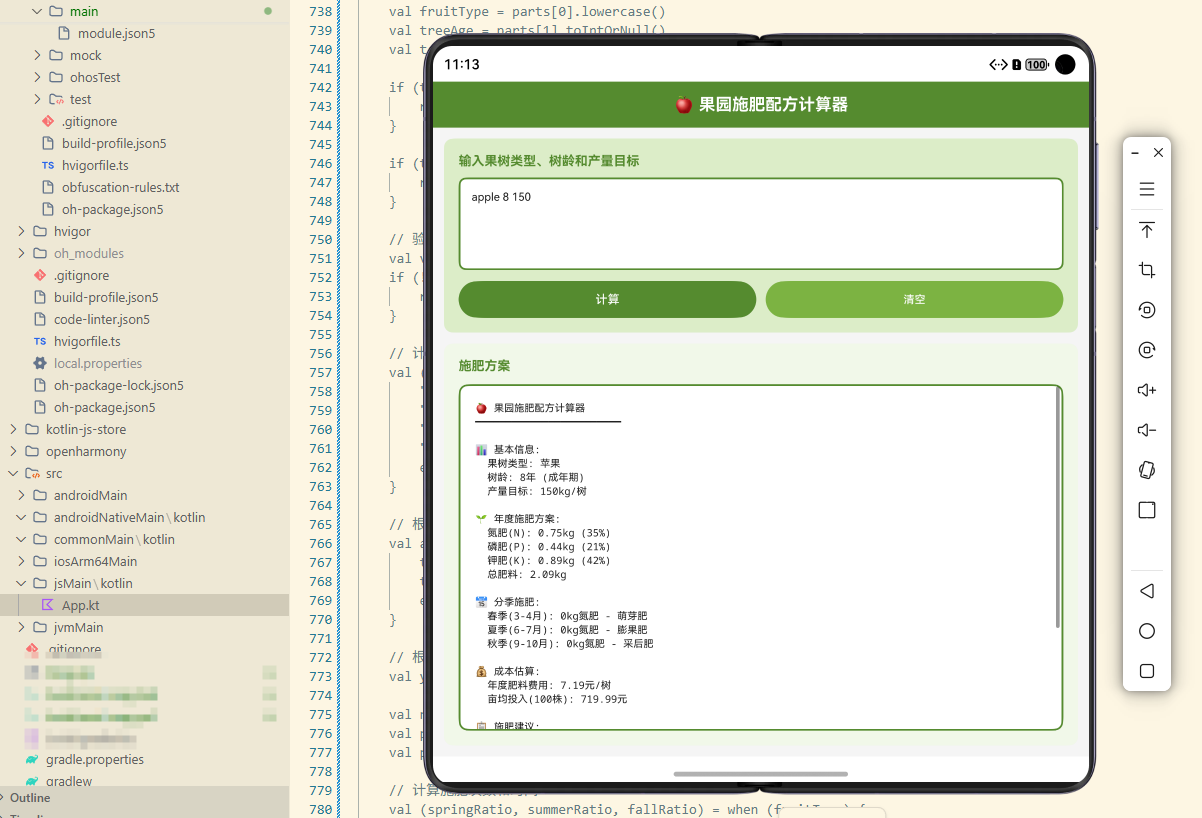
ArkTS版本为OpenHarmony鸿蒙平台提供了完整的用户界面。通过@State装饰器,我们可以管理应用的状态。这个实现包含了果树类型、生长阶段、树木数量、目标产量等输入框,工具选择和结果显示功能。用户可以输入果园参数,选择不同的计算工具,查看施肥方案计算结果。
应用场景分析
1. 精准农业管理
在精准农业中,需要根据果树和土壤状况制定个性化的施肥方案。果农使用施肥计算器来优化施肥管理。
2. 成本控制和优化
在成本控制中,需要在保证产量的前提下降低肥料成本。果农使用施肥计算器来制定最经济的方案。
3. 品质管理和提升
在品质管理中,需要通过科学施肥提高果实品质。果农使用施肥计算器来改善果实品质。
4. 环保和可持续
在环保管理中,需要减少肥料流失和污染。果农使用施肥计算器来实现可持续施肥。
5. 产量预测和规划
在产量预测中,需要根据施肥方案预测果树产量。果农使用施肥计算器来规划生产。
性能优化建议
1. 缓存果树标准
对于常用的果树类型,可以缓存养分标准以提高性能。
2. 优化配方算法
使用更高级的优化算法可以获得更优的施肥配方。
3. 历史数据分析
根据历史施肥数据优化计算模型。
4. 实时土壤监测
与土壤传感器集成实现实时土壤养分监测。
总结
果园施肥配方计算器是现代果树种植中的重要工具。通过在KMP框架下实现这套工具,我们可以在多个平台上使用同一套代码,提高开发效率。这个工具提供了养分需求计算、配方优化、时间规划、土壤补充和效果评估等多种功能,可以满足大多数果园应用的需求。
在OpenHarmony鸿蒙平台上,我们可以通过ArkTS调用这些工具,为果农提供完整的施肥管理体验。掌握这套工具,不仅能够帮助果农科学管理施肥,更重要的是能够在实际项目中灵活应用,解决成本控制、品质提升等实际问题。

作为“人工智能6S店”的官方数字引擎,为AI开发者与企业提供一个覆盖软硬件全栈、一站式门户。
更多推荐

 8
8 0
0- 0


 已为社区贡献3条内容

所有评论(0)