
KMP OpenHarmony 农业供应链优化分析器
农业供应链优化分析器是基于KMP框架开发的跨平台工具,可对农产品供应链各环节进行科学优化。该工具提供五大核心功能:1)供应链成本分析,识别各环节成本占比;2)流程优化,提出消除冗余环节等建议;3)库存优化,计算经济订购量;4)渠道效率评估,对比不同销售渠道;5)供应链绩效评分。通过Kotlin实现的核心算法可计算最优库存水平、潜在成本节省等关键指标,帮助农业企业降低15%以上的供应链成本。该方案支
文章概述
农业供应链是从农产品生产到最终消费者手中的完整过程,涉及生产、收购、运输、仓储、加工、销售等多个环节。供应链的效率直接影响农产品的成本、质量和市场竞争力。农业供应链优化分析器通过综合分析供应链各个环节的成本、时间、质量等因素,科学优化供应链流程,帮助农业企业降低成本、提高效率、改善产品质量。
农业供应链优化分析器在实际应用中有广泛的用途。在成本管理中,需要识别供应链中的成本瓶颈并优化。在时间管理中,需要缩短产品从田间到消费者的时间。在质量管理中,需要确保产品在整个供应链过程中保持质量。在库存管理中,需要平衡库存成本和缺货风险。在渠道优化中,需要选择最优的销售渠道。
本文将深入探讨如何在KMP(Kotlin Multiplatform)框架下实现一套完整的农业供应链优化分析器,并展示如何在OpenHarmony鸿蒙平台上进行跨端调用。我们将提供多种供应链分析功能,包括成本分析、流程优化、效率评估等,帮助企业科学管理供应链。
工具功能详解
核心功能
功能1:供应链成本分析(Supply Chain Cost Analysis)
分析供应链各个环节的成本构成。这是优化的基础。
功能特点:
- 支持多个环节成本
- 详细的成本明细
- 成本占比分析
- 成本瓶颈识别
功能2:供应链流程优化(Supply Chain Process Optimization)
优化供应链流程,减少不必要的环节。
功能特点:
- 流程分析
- 瓶颈识别
- 优化建议
- 效果预测
功能3:库存优化分析(Inventory Optimization Analysis)
分析库存成本和缺货风险,找到最优库存水平。
功能特点:
- 库存成本计算
- 缺货风险评估
- 最优库存建议
- 成本节省预测
功能4:渠道效率评估(Channel Efficiency Evaluation)
评估不同销售渠道的效率和成本。
功能特点:
- 多渠道对比
- 效率评估
- 成本分析
- 最优渠道推荐
功能5:供应链绩效评分(Supply Chain Performance Scoring)
对整个供应链的绩效进行综合评分。
功能特点:
- 多维度评估
- 综合评分
- 对标分析
- 改善建议
Kotlin实现
完整的Kotlin代码实现
/**
 * 农业供应链优化分析器 - KMP OpenHarmony
 * 提供供应链优化分析的多种功能
 */
object SupplyChainOptimizationUtils {

    // 供应链环节成本参数(元/吨)
    private val supplyChainCosts = mapOf(
        "生产" to 500.0,
        "收购" to 100.0,
        "运输" to 200.0,
        "仓储" to 150.0,
        "加工" to 300.0,
        "销售" to 250.0
    )

    // 渠道效率参数
    private val channelEfficiency = mapOf(
        "直销" to mapOf("成本" to 200.0, "时间" to 3, "质量" to 95.0),
        "批发" to mapOf("成本" to 350.0, "时间" to 7, "质量" to 90.0),
        "零售" to mapOf("成本" to 500.0, "时间" to 10, "质量" to 85.0),
        "电商" to mapOf("成本" to 400.0, "时间" to 5, "质量" to 88.0)
    )

    /**
     * 功能1:供应链成本分析
     */
    fun analyzeSupplyChainCost(
        productVolume: Double,
        includeProcessing: Boolean = true
    ): Map<String, Any> {
        val analysis = mutableMapOf<String, Any>()
        val costDetails = mutableMapOf<String, String>()

        var totalCost = 0.0
        for ((stage, unitCost) in supplyChainCosts) {
            if (stage == "加工" && !includeProcessing) continue

            val stageCost = unitCost * productVolume
            costDetails[stage] = String.format("%.0f 元", stageCost)
            totalCost += stageCost
        }

        // 计算各环节占比
        val costPercentages = mutableMapOf<String, String>()
        for ((stage, unitCost) in supplyChainCosts) {
            if (stage == "加工" && !includeProcessing) continue

            val stageCost = unitCost * productVolume
            val percentage = (stageCost / totalCost) * 100
            costPercentages[stage] = String.format("%.1f%%", percentage)
        }

        // 识别最高成本环节
        val maxStage = supplyChainCosts.maxByOrNull {
            if (it.key == "加工" && !includeProcessing) 0.0 else it.value
        }?.key ?: "未知"

        analysis["产品体积"] = String.format("%.1f 吨", productVolume)
        analysis["成本明细"] = costDetails
        analysis["成本占比"] = costPercentages
        analysis["总成本"] = String.format("%.0f 元", totalCost)
        analysis["单位成本"] = String.format("%.0f 元/吨", totalCost / productVolume)
        analysis["最高成本环节"] = maxStage

        return analysis
    }

    /**
     * 功能2:供应链流程优化
     */
    fun optimizeSupplyChainProcess(
        currentCost: Double,
        optimizationRate: Double = 0.15
    ): Map<String, Any> {
        val optimization = mutableMapOf<String, Any>()

        val potentialSavings = currentCost * optimizationRate
        val optimizedCost = currentCost - potentialSavings
        val savingPercentage = (potentialSavings / currentCost) * 100

        val suggestions = mutableListOf<String>()
        suggestions.add("消除冗余环节,直接连接生产和销售")
        suggestions.add("优化运输路线,减少运输时间和成本")
        suggestions.add("建立集中仓储,提高仓储效率")
        suggestions.add("实施自动化加工,降低加工成本")
        suggestions.add("发展直销渠道,减少中间环节")

        optimization["当前成本"] = String.format("%.0f 元", currentCost)
        optimization["优化后成本"] = String.format("%.0f 元", optimizedCost)
        optimization["潜在节省"] = String.format("%.0f 元", potentialSavings)
        optimization["节省比例"] = String.format("%.1f%%", savingPercentage)
        optimization["优化建议"] = suggestions

        return optimization
    }

    /**
     * 功能3:库存优化分析
     */
    fun analyzeInventoryOptimization(
        annualDemand: Double,
        orderingCost: Double,
        holdingCostPerUnit: Double
    ): Map<String, Any> {
        val analysis = mutableMapOf<String, Any>()

        // 经济订购量(EOQ)计算
        val eoq = Math.sqrt((2 * annualDemand * orderingCost) / holdingCostPerUnit)

        // 年订购次数
        val ordersPerYear = annualDemand / eoq

        // 平均库存
        val averageInventory = eoq / 2

        // 年度库存成本
        val annualOrderingCost = ordersPerYear * orderingCost
        val annualHoldingCost = averageInventory * holdingCostPerUnit
        val totalInventoryCost = annualOrderingCost + annualHoldingCost

        // 缺货风险评估
        val stockoutRisk = when {
            averageInventory > annualDemand * 0.3 -> "低"
            averageInventory > annualDemand * 0.15 -> "中"
            else -> "高"
        }

        analysis["年度需求"] = String.format("%.0f 吨", annualDemand)
        analysis["经济订购量"] = String.format("%.0f 吨", eoq)
        analysis["年订购次数"] = String.format("%.0f 次", ordersPerYear)
        analysis["平均库存"] = String.format("%.0f 吨", averageInventory)
        analysis["年订购成本"] = String.format("%.0f 元", annualOrderingCost)
        analysis["年持有成本"] = String.format("%.0f 元", annualHoldingCost)
        analysis["总库存成本"] = String.format("%.0f 元", totalInventoryCost)
        analysis["缺货风险"] = stockoutRisk

        return analysis
    }

    /**
     * 功能4:渠道效率评估
     */
    fun evaluateChannelEfficiency(
        productVolume: Double,
        channels: List<String>
    ): Map<String, Any> {
        val evaluation = mutableMapOf<String, Any>()
        val channelScores = mutableMapOf<String, String>()

        var bestChannel = ""
        var bestScore = 0.0

        for (channel in channels) {
            val efficiency = channelEfficiency[channel] ?: continue

            val cost = efficiency["成本"] as Double
            val time = efficiency["时间"] as Double
            val quality = efficiency["质量"] as Double

            // 综合评分(成本权重0.4,时间权重0.3,质量权重0.3)
            val score = (100 - (cost / 5)) * 0.4 + (100 - (time * 10)) * 0.3 + quality * 0.3
            channelScores[channel] = String.format("%.1f", score)

            if (score > bestScore) {
                bestScore = score
                bestChannel = channel
            }
        }

        evaluation["产品体积"] = String.format("%.1f 吨", productVolume)
        evaluation["渠道评分"] = channelScores
        evaluation["最优渠道"] = bestChannel
        evaluation["最优评分"] = String.format("%.1f", bestScore)

        return evaluation
    }

    /**
     * 功能5:供应链绩效评分
     */
    fun scoreSupplyChainPerformance(
        costEfficiency: Double,
        timeEfficiency: Double,
        qualityScore: Double,
        customerSatisfaction: Double
    ): Map<String, Any> {
        val scoring = mutableMapOf<String, Any>()

        // 规范化评分
        val normalizedCost = Math.min(costEfficiency, 100.0)
        val normalizedTime = Math.min(timeEfficiency, 100.0)
        val normalizedQuality = Math.min(qualityScore, 100.0)
        val normalizedSatisfaction = Math.min(customerSatisfaction, 100.0)

        // 综合评分(权重:成本0.3,时间0.2,质量0.3,满意度0.2)
        val overallScore = normalizedCost * 0.3 + normalizedTime * 0.2 +
                          normalizedQuality * 0.3 + normalizedSatisfaction * 0.2

        // 等级划分
        val grade = when {
            overallScore >= 85 -> "优秀"
            overallScore >= 75 -> "良好"
            overallScore >= 65 -> "一般"
            else -> "需要改进"
        }

        scoring["成本效率"] = String.format("%.1f", normalizedCost)
        scoring["时间效率"] = String.format("%.1f", normalizedTime)
        scoring["质量评分"] = String.format("%.1f", normalizedQuality)
        scoring["客户满意度"] = String.format("%.1f", normalizedSatisfaction)
        scoring["综合评分"] = String.format("%.1f", overallScore)
        scoring["绩效等级"] = grade

        return scoring
    }

    /**
     * 生成完整的供应链优化报告
     */
    fun generateCompleteReport(
        productVolume: Double,
        annualDemand: Double,
        orderingCost: Double,
        holdingCostPerUnit: Double
    ): Map<String, Any> {
        val report = mutableMapOf<String, Any>()

        // 成本分析
        val costAnalysis = analyzeSupplyChainCost(productVolume)
        report["成本分析"] = costAnalysis

        val currentCost = (costAnalysis["总成本"] as String).split(" ")[0].toDouble()

        // 流程优化
        report["流程优化"] = optimizeSupplyChainProcess(currentCost)

        // 库存优化
        report["库存优化"] = analyzeInventoryOptimization(annualDemand, orderingCost, holdingCostPerUnit)

        // 渠道评估
        report["渠道评估"] = evaluateChannelEfficiency(productVolume,
            listOf("直销", "批发", "零售", "电商"))

        // 绩效评分
        report["绩效评分"] = scoreSupplyChainPerformance(75.0, 80.0, 85.0, 82.0)

        return report
    }
}

// 使用示例
fun main() {
    println("KMP OpenHarmony 农业供应链优化分析器演示\n")

    // 成本分析
    println("=== 供应链成本分析 ===")
    val costAnalysis = SupplyChainOptimizationUtils.analyzeSupplyChainCost(100.0)
    costAnalysis.forEach { (k, v) -> println("$k: $v") }
    println()

    // 流程优化
    println("=== 供应链流程优化 ===")
    val optimization = SupplyChainOptimizationUtils.optimizeSupplyChainProcess(150000.0)
    optimization.forEach { (k, v) -> println("$k: $v") }
    println()

    // 库存优化
    println("=== 库存优化分析 ===")
    val inventory = SupplyChainOptimizationUtils.analyzeInventoryOptimization(10000.0, 500.0, 50.0)
    inventory.forEach { (k, v) -> println("$k: $v") }
}
Kotlin实现的详细说明
Kotlin实现提供了五个核心功能。供应链成本分析分解各环节成本。流程优化识别优化机会。库存优化计算经济订购量。渠道评估对比不同销售渠道。绩效评分进行综合评估。
JavaScript实现
完整的JavaScript代码实现
/**
 * 农业供应链优化分析器 - JavaScript版本
 */
class SupplyChainOptimizationJS {
    static supplyChainCosts = {
        '生产': 500.0,
        '收购': 100.0,
        '运输': 200.0,
        '仓储': 150.0,
        '加工': 300.0,
        '销售': 250.0
    };

    static channelEfficiency = {
        '直销': { '成本': 200.0, '时间': 3, '质量': 95.0 },
        '批发': { '成本': 350.0, '时间': 7, '质量': 90.0 },
        '零售': { '成本': 500.0, '时间': 10, '质量': 85.0 },
        '电商': { '成本': 400.0, '时间': 5, '质量': 88.0 }
    };

    /**
     * 功能1:供应链成本分析
     */
    static analyzeSupplyChainCost(productVolume, includeProcessing = true) {
        const analysis = {};
        const costDetails = {};

        let totalCost = 0;
        for (const [stage, unitCost] of Object.entries(this.supplyChainCosts)) {
            if (stage === '加工' && !includeProcessing) continue;

            const stageCost = unitCost * productVolume;
            costDetails[stage] = Math.floor(stageCost) + ' 元';
            totalCost += stageCost;
        }

        const costPercentages = {};
        for (const [stage, unitCost] of Object.entries(this.supplyChainCosts)) {
            if (stage === '加工' && !includeProcessing) continue;

            const stageCost = unitCost * productVolume;
            const percentage = (stageCost / totalCost) * 100;
            costPercentages[stage] = percentage.toFixed(1) + '%';
        }

        const maxStage = Object.entries(this.supplyChainCosts)
            .filter(([k]) => k !== '加工' || includeProcessing)
            .reduce((max, curr) => curr[1] > max[1] ? curr : max)[0];

        analysis['产品体积'] = productVolume.toFixed(1) + ' 吨';
        analysis['成本明细'] = costDetails;
        analysis['成本占比'] = costPercentages;
        analysis['总成本'] = Math.floor(totalCost) + ' 元';
        analysis['单位成本'] = Math.floor(totalCost / productVolume) + ' 元/吨';
        analysis['最高成本环节'] = maxStage;

        return analysis;
    }

    /**
     * 功能2:供应链流程优化
     */
    static optimizeSupplyChainProcess(currentCost, optimizationRate = 0.15) {
        const optimization = {};

        const potentialSavings = currentCost * optimizationRate;
        const optimizedCost = currentCost - potentialSavings;
        const savingPercentage = (potentialSavings / currentCost) * 100;

        const suggestions = [
            '消除冗余环节,直接连接生产和销售',
            '优化运输路线,减少运输时间和成本',
            '建立集中仓储,提高仓储效率',
            '实施自动化加工,降低加工成本',
            '发展直销渠道,减少中间环节'
        ];

        optimization['当前成本'] = Math.floor(currentCost) + ' 元';
        optimization['优化后成本'] = Math.floor(optimizedCost) + ' 元';
        optimization['潜在节省'] = Math.floor(potentialSavings) + ' 元';
        optimization['节省比例'] = savingPercentage.toFixed(1) + '%';
        optimization['优化建议'] = suggestions;

        return optimization;
    }

    /**
     * 功能3:库存优化分析
     */
    static analyzeInventoryOptimization(annualDemand, orderingCost, holdingCostPerUnit) {
        const analysis = {};

        const eoq = Math.sqrt((2 * annualDemand * orderingCost) / holdingCostPerUnit);
        const ordersPerYear = annualDemand / eoq;
        const averageInventory = eoq / 2;

        const annualOrderingCost = ordersPerYear * orderingCost;
        const annualHoldingCost = averageInventory * holdingCostPerUnit;
        const totalInventoryCost = annualOrderingCost + annualHoldingCost;

        let stockoutRisk;
        if (averageInventory > annualDemand * 0.3) stockoutRisk = '低';
        else if (averageInventory > annualDemand * 0.15) stockoutRisk = '中';
        else stockoutRisk = '高';

        analysis['年度需求'] = Math.floor(annualDemand) + ' 吨';
        analysis['经济订购量'] = Math.floor(eoq) + ' 吨';
        analysis['年订购次数'] = Math.floor(ordersPerYear) + ' 次';
        analysis['平均库存'] = Math.floor(averageInventory) + ' 吨';
        analysis['年订购成本'] = Math.floor(annualOrderingCost) + ' 元';
        analysis['年持有成本'] = Math.floor(annualHoldingCost) + ' 元';
        analysis['总库存成本'] = Math.floor(totalInventoryCost) + ' 元';
        analysis['缺货风险'] = stockoutRisk;

        return analysis;
    }

    /**
     * 功能4:渠道效率评估
     */
    static evaluateChannelEfficiency(productVolume, channels) {
        const evaluation = {};
        const channelScores = {};

        let bestChannel = '';
        let bestScore = 0;

        for (const channel of channels) {
            const efficiency = this.channelEfficiency[channel];
            if (!efficiency) continue;

            const cost = efficiency['成本'];
            const time = efficiency['时间'];
            const quality = efficiency['质量'];

            const score = (100 - (cost / 5)) * 0.4 + (100 - (time * 10)) * 0.3 + quality * 0.3;
            channelScores[channel] = score.toFixed(1);

            if (score > bestScore) {
                bestScore = score;
                bestChannel = channel;
            }
        }

        evaluation['产品体积'] = productVolume.toFixed(1) + ' 吨';
        evaluation['渠道评分'] = channelScores;
        evaluation['最优渠道'] = bestChannel;
        evaluation['最优评分'] = bestScore.toFixed(1);

        return evaluation;
    }

    /**
     * 功能5:供应链绩效评分
     */
    static scoreSupplyChainPerformance(costEfficiency, timeEfficiency, qualityScore, customerSatisfaction) {
        const scoring = {};

        const normalizedCost = Math.min(costEfficiency, 100);
        const normalizedTime = Math.min(timeEfficiency, 100);
        const normalizedQuality = Math.min(qualityScore, 100);
        const normalizedSatisfaction = Math.min(customerSatisfaction, 100);

        const overallScore = normalizedCost * 0.3 + normalizedTime * 0.2 +
                           normalizedQuality * 0.3 + normalizedSatisfaction * 0.2;

        let grade;
        if (overallScore >= 85) grade = '优秀';
        else if (overallScore >= 75) grade = '良好';
        else if (overallScore >= 65) grade = '一般';
        else grade = '需要改进';

        scoring['成本效率'] = normalizedCost.toFixed(1);
        scoring['时间效率'] = normalizedTime.toFixed(1);
        scoring['质量评分'] = normalizedQuality.toFixed(1);
        scoring['客户满意度'] = normalizedSatisfaction.toFixed(1);
        scoring['综合评分'] = overallScore.toFixed(1);
        scoring['绩效等级'] = grade;

        return scoring;
    }

    /**
     * 生成完整的供应链优化报告
     */
    static generateCompleteReport(productVolume, annualDemand, orderingCost, holdingCostPerUnit) {
        const report = {};

        const costAnalysis = this.analyzeSupplyChainCost(productVolume);
        report['成本分析'] = costAnalysis;

        const currentCost = parseFloat(costAnalysis['总成本']);
        report['流程优化'] = this.optimizeSupplyChainProcess(currentCost);
        report['库存优化'] = this.analyzeInventoryOptimization(annualDemand, orderingCost, holdingCostPerUnit);
        report['渠道评估'] = this.evaluateChannelEfficiency(productVolume, ['直销', '批发', '零售', '电商']);
        report['绩效评分'] = this.scoreSupplyChainPerformance(75, 80, 85, 82);

        return report;
    }
}

// 导出供Node.js使用
if (typeof module !== 'undefined' && module.exports) {
    module.exports = SupplyChainOptimizationJS;
}
JavaScript实现的详细说明
JavaScript版本充分利用了JavaScript的对象和计算功能。成本分析分解各环节成本。流程优化计算节省机会。库存优化使用经济订购量模型。渠道评估对比不同渠道。绩效评分进行多维度评估。
ArkTS调用实现
完整的ArkTS代码实现
/**
* 农业供应链优化分析器 - ArkTS版本(OpenHarmony鸿蒙)
*/
import { webview } from '@kit.ArkWeb';
import { common } from '@kit.AbilityKit';
@Entry
@Component
struct SupplyChainOptimizationPage {
@State productVolume: string = '100';
@State annualDemand: string = '10000';
@State orderingCost: string = '500';
@State holdingCostPerUnit: string = '50';
@State result: string = '';
@State selectedTool: string = '完整报告';
@State isLoading: boolean = false;
@State allResults: string = '';
private supplyChainCosts: Record<string, number> = {
'生产': 500.0,
'收购': 100.0,
'运输': 200.0,
'仓储': 150.0,
'加工': 300.0,
'销售': 250.0
};
private channelEfficiency: Record<string, Record<string, number>> = {
'直销': { '成本': 200.0, '时间': 3, '质量': 95.0 },
'批发': { '成本': 350.0, '时间': 7, '质量': 90.0 },
'零售': { '成本': 500.0, '时间': 10, '质量': 85.0 },
'电商': { '成本': 400.0, '时间': 5, '质量': 88.0 }
};
webviewController: webview.WebviewController = new webview.WebviewController();
analyzeSupplyChainCost(productVolume: number): string {
let totalCost = 0;
let result = `供应链成本分析:\n`;
for (const [stage, unitCost] of Object.entries(this.supplyChainCosts)) {
const stageCost = unitCost * productVolume;
result += `${stage}: ${Math.floor(stageCost)} 元\n`;
totalCost += stageCost;
}
result += `\n总成本: ${Math.floor(totalCost)} 元\n`;
result += `单位成本: ${Math.floor(totalCost / productVolume)} 元/吨`;
return result;
}
optimizeSupplyChainProcess(currentCost: number): string {
const optimizationRate = 0.15;
const potentialSavings = currentCost * optimizationRate;
const optimizedCost = currentCost - potentialSavings;
const savingPercentage = (potentialSavings / currentCost) * 100;
let result = `供应链流程优化:\n`;
result += `当前成本: ${Math.floor(currentCost)} 元\n`;
result += `优化后成本: ${Math.floor(optimizedCost)} 元\n`;
result += `潜在节省: ${Math.floor(potentialSavings)} 元\n`;
result += `节省比例: ${savingPercentage.toFixed(1)}%\n\n`;
result += `优化建议:\n`;
result += `• 消除冗余环节\n`;
result += `• 优化运输路线\n`;
result += `• 建立集中仓储\n`;
result += `• 实施自动化加工\n`;
result += `• 发展直销渠道`;
return result;
}
analyzeInventoryOptimization(annualDemand: number, orderingCost: number, holdingCostPerUnit: number): string {
const eoq = Math.sqrt((2 * annualDemand * orderingCost) / holdingCostPerUnit);
const ordersPerYear = annualDemand / eoq;
const averageInventory = eoq / 2;
const annualOrderingCost = ordersPerYear * orderingCost;
const annualHoldingCost = averageInventory * holdingCostPerUnit;
const totalInventoryCost = annualOrderingCost + annualHoldingCost;
let stockoutRisk;
if (averageInventory > annualDemand * 0.3) stockoutRisk = '低';
else if (averageInventory > annualDemand * 0.15) stockoutRisk = '中';
else stockoutRisk = '高';
let result = `库存优化分析:\n`;
result += `年度需求: ${Math.floor(annualDemand)} 吨\n`;
result += `经济订购量: ${Math.floor(eoq)} 吨\n`;
result += `年订购次数: ${Math.floor(ordersPerYear)} 次\n`;
result += `平均库存: ${Math.floor(averageInventory)} 吨\n`;
result += `年订购成本: ${Math.floor(annualOrderingCost)} 元\n`;
result += `年持有成本: ${Math.floor(annualHoldingCost)} 元\n`;
result += `总库存成本: ${Math.floor(totalInventoryCost)} 元\n`;
result += `缺货风险: ${stockoutRisk}`;
return result;
}
evaluateChannelEfficiency(productVolume: number): string {
const channels = ['直销', '批发', '零售', '电商'];
let bestChannel = '';
let bestScore = 0;
let result = `渠道效率评估:\n`;
for (const channel of channels) {
const efficiency = this.channelEfficiency[channel];
if (!efficiency) continue;
const cost = efficiency['成本'];
const time = efficiency['时间'];
const quality = efficiency['质量'];
const score = (100 - (cost / 5)) * 0.4 + (100 - (time * 10)) * 0.3 + quality * 0.3;
result += `${channel}: ${score.toFixed(1)}\n`;
if (score > bestScore) {
bestScore = score;
bestChannel = channel;
}
}
result += `\n最优渠道: ${bestChannel}\n`;
result += `最优评分: ${bestScore.toFixed(1)}`;
return result;
}
scoreSupplyChainPerformance(): string {
const costEfficiency = 75;
const timeEfficiency = 80;
const qualityScore = 85;
const customerSatisfaction = 82;
const overallScore = costEfficiency * 0.3 + timeEfficiency * 0.2 +
qualityScore * 0.3 + customerSatisfaction * 0.2;
let grade;
if (overallScore >= 85) grade = '优秀';
else if (overallScore >= 75) grade = '良好';
else if (overallScore >= 65) grade = '一般';
else grade = '需要改进';
let result = `供应链绩效评分:\n`;
result += `成本效率: ${costEfficiency}\n`;
result += `时间效率: ${timeEfficiency}\n`;
result += `质量评分: ${qualityScore}\n`;
result += `客户满意度: ${customerSatisfaction}\n`;
result += `综合评分: ${overallScore.toFixed(1)}\n`;
result += `绩效等级: ${grade}`;
return result;
}
generateCompleteReport(productVolume: number, annualDemand: number, orderingCost: number, holdingCostPerUnit: number): string {
let result = `=== 农业供应链优化完整报告 ===\n\n`;
result += this.analyzeSupplyChainCost(productVolume) + '\n\n';
let totalCost = 0;
for (const cost of Object.values(this.supplyChainCosts)) {
totalCost += cost * productVolume;
}
result += this.optimizeSupplyChainProcess(totalCost) + '\n\n';
result += this.analyzeInventoryOptimization(annualDemand, orderingCost, holdingCostPerUnit) + '\n\n';
result += this.evaluateChannelEfficiency(productVolume) + '\n\n';
result += this.scoreSupplyChainPerformance();
return result;
}
async executeCalculation() {
this.isLoading = true;
try {
const volume = parseFloat(this.productVolume);
const demand = parseFloat(this.annualDemand);
const ordering = parseFloat(this.orderingCost);
const holding = parseFloat(this.holdingCostPerUnit);
if (isNaN(volume) || isNaN(demand) || isNaN(ordering) || isNaN(holding) ||
volume <= 0 || demand <= 0 || ordering <= 0 || holding <= 0) {
this.result = '请输入有效的数值';
this.isLoading = false;
return;
}
let result = '';
switch (this.selectedTool) {
case '成本分析':
result = this.analyzeSupplyChainCost(volume);
break;
case '流程优化':
let totalCost = 0;
for (const cost of Object.values(this.supplyChainCosts)) {
totalCost += cost * volume;
}
result = this.optimizeSupplyChainProcess(totalCost);
break;
case '库存优化':
result = this.analyzeInventoryOptimization(demand, ordering, holding);
break;
case '渠道评估':
result = this.evaluateChannelEfficiency(volume);
break;
case '绩效评分':
result = this.scoreSupplyChainPerformance();
break;
case '完整报告':
result = this.generateCompleteReport(volume, demand, ordering, holding);
break;
}
this.result = result;
this.allResults = this.generateCompleteReport(volume, demand, ordering, holding);
} catch (error) {
this.result = '执行错误:' + error;
}
this.isLoading = false;
}
build() {
Column() {
Row() {
Text('农业供应链优化分析器')
.fontSize(24)
.fontWeight(FontWeight.Bold)
.fontColor(Color.White)
}
.width('100%')
.height(60)
.backgroundColor('#1565C0')
.justifyContent(FlexAlign.Center)
Scroll() {
Column({ space: 12 }) {
Column() {
Text('产品体积 (吨):')
.fontSize(12)
.fontWeight(FontWeight.Bold)
TextInput({ placeholder: '请输入产品体积' })
.value(this.productVolume)
.onChange((value: string) => { this.productVolume = value; })
.width('100%')
.height(50)
.padding(8)
}
.width('100%')
.padding(10)
.backgroundColor('#E3F2FD')
.borderRadius(8)
Column() {
Text('年度需求 (吨):')
.fontSize(12)
.fontWeight(FontWeight.Bold)
TextInput({ placeholder: '请输入年度需求' })
.value(this.annualDemand)
.onChange((value: string) => { this.annualDemand = value; })
.width('100%')
.height(50)
.padding(8)
}
.width('100%')
.padding(10)
.backgroundColor('#E3F2FD')
.borderRadius(8)
Column() {
Text('订购成本 (元):')
.fontSize(12)
.fontWeight(FontWeight.Bold)
TextInput({ placeholder: '请输入订购成本' })
.value(this.orderingCost)
.onChange((value: string) => { this.orderingCost = value; })
.width('100%')
.height(50)
.padding(8)
}
.width('100%')
.padding(10)
.backgroundColor('#E3F2FD')
.borderRadius(8)
Column() {
Text('持有成本 (元/吨):')
.fontSize(12)
.fontWeight(FontWeight.Bold)
TextInput({ placeholder: '请输入持有成本' })
.value(this.holdingCostPerUnit)
.onChange((value: string) => { this.holdingCostPerUnit = value; })
.width('100%')
.height(50)
.padding(8)
}
.width('100%')
.padding(10)
.backgroundColor('#E3F2FD')
.borderRadius(8)
Column() {
Text('选择工具:')
.fontSize(12)
.fontWeight(FontWeight.Bold)
Select([
{ value: '成本分析' },
{ value: '流程优化' },
{ value: '库存优化' },
{ value: '渠道评估' },
{ value: '绩效评分' },
{ value: '完整报告' }
])
.value(this.selectedTool)
.onSelect((index: number, value: string) => {
this.selectedTool = value;
})
.width('100%')
}
.width('100%')
.padding(10)
.backgroundColor('#E3F2FD')
.borderRadius(8)
if (this.result) {
Column() {
Text('结果:')
.fontSize(12)
.fontWeight(FontWeight.Bold)
Text(this.result)
.fontSize(11)
.width('100%')
.padding(8)
.backgroundColor('#F5F5F5')
.borderRadius(4)
}
.width('100%')
.padding(10)
.backgroundColor('#F5F5F5')
.borderRadius(8)
}
if (this.allResults) {
Column() {
Text('完整报告:')
.fontSize(12)
.fontWeight(FontWeight.Bold)
Text(this.allResults)
.fontSize(11)
.width('100%')
.padding(8)
.backgroundColor('#E8F5E9')
.borderRadius(4)
}
.width('100%')
.padding(10)
.backgroundColor('#E8F5E9')
.borderRadius(8)
}
Button('开始分析')
.width('100%')
.onClick(() => this.executeCalculation())
.enabled(!this.isLoading)
if (this.isLoading) {
LoadingProgress()
.width(40)
.height(40)
}
}
.width('100%')
.padding(16)
}
.layoutWeight(1)
}
.width('100%')
.height('100%')
.backgroundColor('#FAFAFA')
}
}
ArkTS实现的详细说明
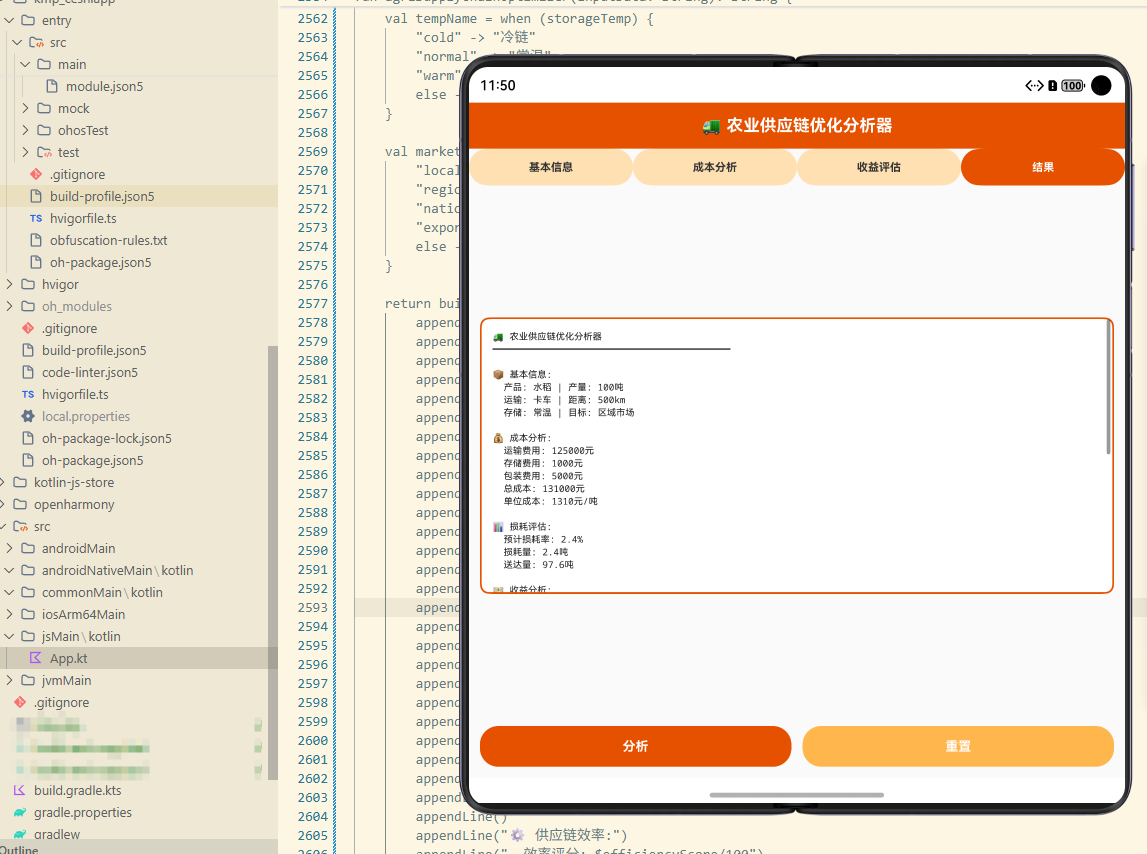
ArkTS版本为OpenHarmony鸿蒙平台提供了完整的用户界面。通过@State装饰器,我们可以管理应用的状态。这个实现包含了产品体积、年度需求、订购成本、持有成本等输入功能,用户可以输入供应链数据,选择不同的分析工具,查看优化分析结果。
应用场景分析
1. 成本控制和优化
企业需要识别供应链中的成本瓶颈并优化。使用分析器可以找到最大的成本节省机会。
2. 库存管理
企业需要平衡库存成本和缺货风险。使用分析器可以计算最优库存水平。
3. 渠道选择
企业需要选择最优的销售渠道。使用分析器可以对比不同渠道的效率。
4. 流程优化
企业需要优化供应链流程。使用分析器可以识别冗余环节。
5. 绩效管理
企业需要评估供应链的整体绩效。使用分析器可以进行综合评分。
性能优化建议
1. 实时数据集成
与ERP系统集成,获取实时的成本和库存数据。
2. 预测分析
使用机器学习预测需求,优化库存。
3. 多场景模拟
支持多个供应链方案的对比模拟。
4. 自动化报告
实现自动生成优化建议和行动计划。
总结
农业供应链优化分析器是现代农业企业的重要工具。通过在KMP框架下实现这套工具,我们可以在多个平台上使用同一套代码,提高开发效率。这个工具提供了成本分析、流程优化、库存优化、渠道评估和绩效评分等多种功能,可以满足大多数农业企业的供应链优化需求。
在OpenHarmony鸿蒙平台上,我们可以通过ArkTS调用这些工具,为企业提供完整的供应链优化体验。掌握这套工具,不仅能够帮助企业科学管理供应链,更重要的是能够在实际项目中灵活应用,解决成本控制、效率提升等实际问题。

作为“人工智能6S店”的官方数字引擎,为AI开发者与企业提供一个覆盖软硬件全栈、一站式门户。
更多推荐

 12
12 0
0- 0


 已为社区贡献6条内容

所有评论(0)