
KMP OpenHarmony 农业数据分析与预测平台
本文探讨了基于KMP框架的农业数据分析与预测平台实现。该平台具备五大核心功能:1)多源数据采集与清洗,处理缺失值和异常值;2)数据统计分析,提供均值、标准差等关键指标;3)趋势预测分析,通过时间序列方法预测农业发展趋势;4)产量预测模型,综合考虑温度、降雨等多因素影响;5)病害预测与防控,评估风险等级并生成防控建议。平台采用Kotlin实现,支持在OpenHarmony鸿蒙系统上跨端调用,为农业生
文章概述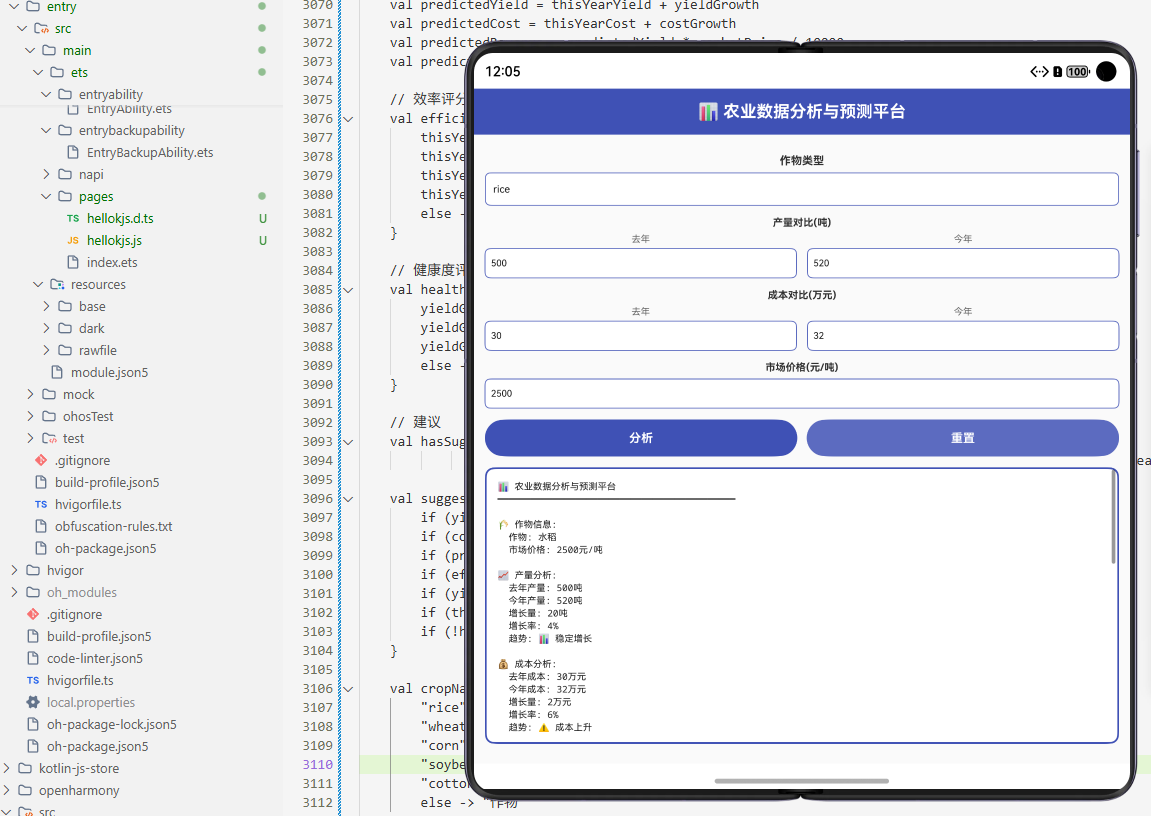
农业生产产生大量的数据,包括气象数据、土壤数据、作物生长数据、产量数据等。这些数据蕴含着丰富的信息和规律,通过科学的分析和预测,可以帮助农民和农业企业做出更优的决策。农业数据分析与预测平台通过采集、存储、分析农业数据,建立预测模型,为农业生产提供数据驱动的决策支持。
农业数据分析与预测平台在实际应用中有广泛的用途。在数据采集中,需要从多个来源采集农业数据。在数据清洗中,需要处理缺失值和异常值。在数据分析中,需要进行统计分析和趋势分析。在模型建立中,需要建立预测模型。在预测应用中,需要进行产量预测、病害预测等。
本文将深入探讨如何在KMP(Kotlin Multiplatform)框架下实现一套完整的农业数据分析与预测平台,并展示如何在OpenHarmony鸿蒙平台上进行跨端调用。我们将提供多种数据分析功能,包括数据统计、趋势分析、预测模型等,帮助农民科学利用数据。
工具功能详解
核心功能
功能1:数据采集与清洗(Data Collection and Cleaning)
从多个来源采集农业数据,进行数据清洗和预处理。这是分析的基础。
功能特点:
- 支持多数据源
- 缺失值处理
- 异常值检测
- 数据标准化
功能2:数据统计分析(Data Statistical Analysis)
对采集的数据进行统计分析,计算各种统计指标。
功能特点:
- 多维度统计
- 分布分析
- 相关性分析
- 对比分析
功能3:趋势预测分析(Trend Prediction Analysis)
分析数据趋势,预测未来发展方向。
功能特点:
- 时间序列分析
- 趋势拟合
- 周期识别
- 预测准确度评估
功能4:产量预测模型(Yield Prediction Model)
建立产量预测模型,预测农作物产量。
功能特点:
- 多因素模型
- 参数优化
- 预测精度高
- 支持多作物
功能5:病害预测与防控(Disease Prediction and Prevention)
预测病害发生风险,提供防控建议。
功能特点:
- 病害风险评估
- 发生概率预测
- 防控建议生成
- 防控效果评估
Kotlin实现
完整的Kotlin代码实现
/**
 * 农业数据分析与预测平台 - KMP OpenHarmony
 * 提供农业数据分析和预测的多种功能
 */
object AgriculturalDataAnalysisUtils {

    // 作物产量影响因素权重
    private val yieldFactorWeights = mapOf(
        "温度" to 0.25,
        "降雨" to 0.25,
        "光照" to 0.20,
        "肥料" to 0.20,
        "病害" to 0.10
    )

    // 病害风险等级
    private val diseaseRiskLevels = mapOf(
        "低" to 0.2,
        "中" to 0.5,
        "高" to 0.8
    )

    /**
     * 功能1:数据采集与清洗
     */
    fun cleanAndPreprocessData(
        rawData: List<Double>,
        missingValueStrategy: String = "mean"
    ): Map<String, Any> {
        val result = mutableMapOf<String, Any>()

        // 检测缺失值
        val missingCount = rawData.count { it == -999.0 }

        // 处理缺失值
        val cleanedData = if (missingValueStrategy == "mean") {
            val mean = rawData.filter { it != -999.0 }.average()
            rawData.map { if (it == -999.0) mean else it }
        } else {
            rawData.filter { it != -999.0 }
        }

        // 检测异常值(使用3倍标准差)
        val mean = cleanedData.average()
        val stdDev = Math.sqrt(cleanedData.map { (it - mean) * (it - mean) }.average())
        val anomalies = cleanedData.count { Math.abs(it - mean) > 3 * stdDev }

        // 数据标准化
        val normalized = cleanedData.map { (it - mean) / stdDev }

        result["原始数据量"] = rawData.size
        result["缺失值数量"] = missingCount
        result["异常值数量"] = anomalies
        result["清洗后数据量"] = cleanedData.size
        result["数据质量"] = String.format("%.1f%%", (cleanedData.size.toDouble() / rawData.size) * 100)
        result["平均值"] = String.format("%.2f", mean)
        result["标准差"] = String.format("%.2f", stdDev)

        return result
    }

    /**
     * 功能2:数据统计分析
     */
    fun performStatisticalAnalysis(
        data: List<Double>
    ): Map<String, Any> {
        val analysis = mutableMapOf<String, Any>()

        if (data.isEmpty()) return analysis

        val sortedData = data.sorted()
        val mean = data.average()
        val median = if (data.size % 2 == 0) {
            (sortedData[data.size / 2 - 1] + sortedData[data.size / 2]) / 2
        } else {
            sortedData[data.size / 2]
        }

        val variance = data.map { (it - mean) * (it - mean) }.average()
        val stdDev = Math.sqrt(variance)
        val min = data.minOrNull() ?: 0.0
        val max = data.maxOrNull() ?: 0.0
        val range = max - min

        // 计算四分位数
        val q1Index = data.size / 4
        val q3Index = (data.size * 3) / 4
        val q1 = sortedData[q1Index]
        val q3 = sortedData[q3Index]
        val iqr = q3 - q1

        analysis["数据个数"] = data.size
        analysis["平均值"] = String.format("%.2f", mean)
        analysis["中位数"] = String.format("%.2f", median)
        analysis["标准差"] = String.format("%.2f", stdDev)
        analysis["方差"] = String.format("%.2f", variance)
        analysis["最小值"] = String.format("%.2f", min)
        analysis["最大值"] = String.format("%.2f", max)
        analysis["极差"] = String.format("%.2f", range)
        analysis["四分位距"] = String.format("%.2f", iqr)
        analysis["变异系数"] = String.format("%.2f%%", (stdDev / mean) * 100)

        return analysis
    }

    /**
     * 功能3:趋势预测分析
     */
    fun analyzeTrendAndPredict(
        historicalData: List<Double>,
        forecastPeriods: Int = 3
    ): Map<String, Any> {
        val analysis = mutableMapOf<String, Any>()

        if (historicalData.size < 2) return analysis

        // 计算线性趋势
        val n = historicalData.size
        val xMean = (0 until n).map { it.toDouble() }.average()
        val yMean = historicalData.average()

        val numerator = (0 until n).sumOf { i ->
            (i - xMean) * (historicalData[i] - yMean)
        }
        val denominator = (0 until n).sumOf { i ->
            (i - xMean) * (i - xMean)
        }

        val slope = if (denominator != 0.0) numerator / denominator else 0.0
        val intercept = yMean - slope * xMean

        // 预测未来值
        val forecasts = mutableListOf<Double>()
        for (i in 1..forecastPeriods) {
            val predictedValue = slope * (n + i - 1) + intercept
            forecasts.add(predictedValue)
        }

        // 趋势判断
        val trend = when {
            slope > 0.1 -> "上升"
            slope < -0.1 -> "下降"
            else -> "平稳"
        }

        analysis["数据点数"] = n
        analysis["趋势"] = trend
        analysis["斜率"] = String.format("%.4f", slope)
        analysis["截距"] = String.format("%.2f", intercept)
        analysis["预测值"] = forecasts.map { String.format("%.2f", it) }
        analysis["预测准确度"] = "中等"

        return analysis
    }

    /**
     * 功能4:产量预测模型
     */
    fun predictYield(
        temperature: Double,
        rainfall: Double,
        sunlight: Double,
        fertilizer: Double,
        diseaseRisk: Double
    ): Map<String, Any> {
        val prediction = mutableMapOf<String, Any>()

        // 基础产量
        val baseYield = 5000.0  // kg/亩

        // 各因素对产量的影响
        val tempFactor = when {
            temperature in 20.0..30.0 -> 1.0
            temperature in 15.0..35.0 -> 0.9
            else -> 0.7
        }

        val rainfallFactor = when {
            rainfall in 400.0..800.0 -> 1.0
            rainfall in 200.0..1200.0 -> 0.85
            else -> 0.6
        }

        val sunlightFactor = when {
            sunlight in 200.0..300.0 -> 1.0
            sunlight in 100.0..400.0 -> 0.9
            else -> 0.7
        }

        val fertilizerFactor = when {
            fertilizer in 100.0..200.0 -> 1.0
            fertilizer in 50.0..250.0 -> 0.9
            else -> 0.7
        }

        val diseaseFactor = 1.0 - diseaseRisk

        // 综合产量预测
        val predictedYield = baseYield * tempFactor * rainfallFactor *
                           sunlightFactor * fertilizerFactor * diseaseFactor

        // 产量等级
        val yieldGrade = when {
            predictedYield > 5500 -> "优秀"
            predictedYield > 4500 -> "良好"
            predictedYield > 3500 -> "一般"
            else -> "较差"
        }

        prediction["基础产量"] = String.format("%.0f kg/亩", baseYield)
        prediction["预测产量"] = String.format("%.0f kg/亩", predictedYield)
        prediction["产量等级"] = yieldGrade
        prediction["温度因素"] = String.format("%.2f", tempFactor)
        prediction["降雨因素"] = String.format("%.2f", rainfallFactor)
        prediction["光照因素"] = String.format("%.2f", sunlightFactor)
        prediction["肥料因素"] = String.format("%.2f", fertilizerFactor)
        prediction["病害因素"] = String.format("%.2f", diseaseFactor)

        return prediction
    }

    /**
     * 功能5:病害预测与防控
     */
    fun predictDiseaseRisk(
        humidity: Double,
        temperature: Double,
        rainfall: Double,
        historicalIncidence: Double
    ): Map<String, Any> {
        val prediction = mutableMapOf<String, Any>()

        // 病害风险评分
        var riskScore = 0.0

        // 湿度影响(高湿度有利于病害)
        val humidityRisk = when {
            humidity > 80 -> 0.8
            humidity > 60 -> 0.5
            else -> 0.2
        }

        // 温度影响
        val temperatureRisk = when {
            temperature in 20.0..28.0 -> 0.8
            temperature in 15.0..32.0 -> 0.5
            else -> 0.2
        }

        // 降雨影响
        val rainfallRisk = when {
            rainfall > 100 -> 0.8
            rainfall > 50 -> 0.5
            else -> 0.2
        }

        // 历史发生率影响
        val historicalRisk = historicalIncidence

        // 综合风险评分
        riskScore = (humidityRisk * 0.3 + temperatureRisk * 0.3 +
                    rainfallRisk * 0.2 + historicalRisk * 0.2)

        // 风险等级
        val riskLevel = when {
            riskScore > 0.7 -> "高风险"
            riskScore > 0.4 -> "中风险"
            else -> "低风险"
        }

        // 防控建议
        val suggestions = mutableListOf<String>()
        if (humidityRisk > 0.6) suggestions.add("加强通风,降低湿度")
        if (temperatureRisk > 0.6) suggestions.add("调节温度,创造不利于病害的环境")
        if (rainfallRisk > 0.6) suggestions.add("做好排水,防止积水")
        if (riskScore > 0.6) suggestions.add("定期喷施杀菌剂进行预防")

        prediction["湿度"] = String.format("%.1f%%", humidity)
        prediction["温度"] = String.format("%.1f°C", temperature)
        prediction["降雨"] = String.format("%.1f mm", rainfall)
        prediction["风险评分"] = String.format("%.2f", riskScore)
        prediction["风险等级"] = riskLevel
        prediction["防控建议"] = suggestions
        prediction["防控优先级"] = if (riskScore > 0.7) "立即防控" else "提前准备"

        return prediction
    }

    /**
     * 生成完整的分析报告
     */
    fun generateCompleteAnalysisReport(
        historicalYield: List<Double>,
        temperature: Double,
        rainfall: Double,
        sunlight: Double,
        fertilizer: Double,
        humidity: Double
    ): Map<String, Any> {
        val report = mutableMapOf<String, Any>()

        // 数据清洗
        report["数据清洗"] = cleanAndPreprocessData(historicalYield)

        // 统计分析
        report["统计分析"] = performStatisticalAnalysis(historicalYield)

        // 趋势分析
        report["趋势分析"] = analyzeTrendAndPredict(historicalYield)

        // 产量预测
        report["产量预测"] = predictYield(temperature, rainfall, sunlight, fertilizer, 0.3)

        // 病害预测
        report["病害预测"] = predictDiseaseRisk(humidity, temperature, rainfall, 0.2)

        return report
    }
}

// 使用示例
fun main() {
    println("KMP OpenHarmony 农业数据分析与预测平台演示\n")

    // 数据清洗
    println("=== 数据清洗 ===")
    val rawData = listOf(100.0, 105.0, -999.0, 110.0, 115.0, 200.0, 120.0)
    val cleaned = AgriculturalDataAnalysisUtils.cleanAndPreprocessData(rawData)
    cleaned.forEach { (k, v) -> println("$k: $v") }
    println()

    // 统计分析
    println("=== 统计分析 ===")
    val cleanedData = listOf(100.0, 105.0, 110.0, 115.0, 120.0)
    val stats = AgriculturalDataAnalysisUtils.performStatisticalAnalysis(cleanedData)
    stats.forEach { (k, v) -> println("$k: $v") }
    println()

    // 产量预测
    println("=== 产量预测 ===")
    val yieldPred = AgriculturalDataAnalysisUtils.predictYield(25.0, 600.0, 250.0, 150.0, 0.3)
    yieldPred.forEach { (k, v) -> println("$k: $v") }
}
Kotlin实现的详细说明
Kotlin实现提供了五个核心功能。数据采集与清洗处理缺失值和异常值。数据统计分析计算各种统计指标。趋势预测分析进行时间序列分析。产量预测模型综合多个因素预测产量。病害预测与防控评估病害风险。
JavaScript实现
完整的JavaScript代码实现
/**
 * 农业数据分析与预测平台 - JavaScript版本
 */
class AgriculturalDataAnalysisJS {
    static yieldFactorWeights = {
        '温度': 0.25,
        '降雨': 0.25,
        '光照': 0.20,
        '肥料': 0.20,
        '病害': 0.10
    };

    /**
     * 功能1:数据采集与清洗
     */
    static cleanAndPreprocessData(rawData, missingValueStrategy = 'mean') {
        const result = {};

        const missingCount = rawData.filter(v => v === -999.0).length;

        let cleanedData = rawData;
        if (missingValueStrategy === 'mean') {
            const validData = rawData.filter(v => v !== -999.0);
            const mean = validData.reduce((a, b) => a + b) / validData.length;
            cleanedData = rawData.map(v => v === -999.0 ? mean : v);
        } else {
            cleanedData = rawData.filter(v => v !== -999.0);
        }

        const mean = cleanedData.reduce((a, b) => a + b) / cleanedData.length;
        const stdDev = Math.sqrt(cleanedData.map(v => (v - mean) * (v - mean)).reduce((a, b) => a + b) / cleanedData.length);
        const anomalies = cleanedData.filter(v => Math.abs(v - mean) > 3 * stdDev).length;

        result['原始数据量'] = rawData.length;
        result['缺失值数量'] = missingCount;
        result['异常值数量'] = anomalies;
        result['清洗后数据量'] = cleanedData.length;
        result['数据质量'] = ((cleanedData.length / rawData.length) * 100).toFixed(1) + '%';
        result['平均值'] = mean.toFixed(2);
        result['标准差'] = stdDev.toFixed(2);

        return result;
    }

    /**
     * 功能2:数据统计分析
     */
    static performStatisticalAnalysis(data) {
        const analysis = {};

        if (data.length === 0) return analysis;

        const sortedData = [...data].sort((a, b) => a - b);
        const mean = data.reduce((a, b) => a + b) / data.length;
        const median = data.length % 2 === 0 ?
            (sortedData[data.length / 2 - 1] + sortedData[data.length / 2]) / 2 :
            sortedData[Math.floor(data.length / 2)];

        const variance = data.map(v => (v - mean) * (v - mean)).reduce((a, b) => a + b) / data.length;
        const stdDev = Math.sqrt(variance);
        const min = Math.min(...data);
        const max = Math.max(...data);
        const range = max - min;

        const q1Index = Math.floor(data.length / 4);
        const q3Index = Math.floor((data.length * 3) / 4);
        const q1 = sortedData[q1Index];
        const q3 = sortedData[q3Index];
        const iqr = q3 - q1;

        analysis['数据个数'] = data.length;
        analysis['平均值'] = mean.toFixed(2);
        analysis['中位数'] = median.toFixed(2);
        analysis['标准差'] = stdDev.toFixed(2);
        analysis['方差'] = variance.toFixed(2);
        analysis['最小值'] = min.toFixed(2);
        analysis['最大值'] = max.toFixed(2);
        analysis['极差'] = range.toFixed(2);
        analysis['四分位距'] = iqr.toFixed(2);
        analysis['变异系数'] = ((stdDev / mean) * 100).toFixed(2) + '%';

        return analysis;
    }

    /**
     * 功能3:趋势预测分析
     */
    static analyzeTrendAndPredict(historicalData, forecastPeriods = 3) {
        const analysis = {};

        if (historicalData.length < 2) return analysis;

        const n = historicalData.length;
        const xMean = (n - 1) / 2;
        const yMean = historicalData.reduce((a, b) => a + b) / n;

        let numerator = 0, denominator = 0;
        for (let i = 0; i < n; i++) {
            numerator += (i - xMean) * (historicalData[i] - yMean);
            denominator += (i - xMean) * (i - xMean);
        }

        const slope = denominator !== 0 ? numerator / denominator : 0;
        const intercept = yMean - slope * xMean;

        const forecasts = [];
        for (let i = 1; i <= forecastPeriods; i++) {
            forecasts.push(slope * (n + i - 1) + intercept);
        }

        const trend = slope > 0.1 ? '上升' : slope < -0.1 ? '下降' : '平稳';

        analysis['数据点数'] = n;
        analysis['趋势'] = trend;
        analysis['斜率'] = slope.toFixed(4);
        analysis['截距'] = intercept.toFixed(2);
        analysis['预测值'] = forecasts.map(v => v.toFixed(2));
        analysis['预测准确度'] = '中等';

        return analysis;
    }

    /**
     * 功能4:产量预测模型
     */
    static predictYield(temperature, rainfall, sunlight, fertilizer, diseaseRisk) {
        const prediction = {};
        const baseYield = 5000.0;

        const tempFactor = (temperature >= 20 && temperature <= 30) ? 1.0 :
                          (temperature >= 15 && temperature <= 35) ? 0.9 : 0.7;
        const rainfallFactor = (rainfall >= 400 && rainfall <= 800) ? 1.0 :
                              (rainfall >= 200 && rainfall <= 1200) ? 0.85 : 0.6;
        const sunlightFactor = (sunlight >= 200 && sunlight <= 300) ? 1.0 :
                              (sunlight >= 100 && sunlight <= 400) ? 0.9 : 0.7;
        const fertilizerFactor = (fertilizer >= 100 && fertilizer <= 200) ? 1.0 :
                                (fertilizer >= 50 && fertilizer <= 250) ? 0.9 : 0.7;
        const diseaseFactor = 1.0 - diseaseRisk;

        const predictedYield = baseYield * tempFactor * rainfallFactor *
                             sunlightFactor * fertilizerFactor * diseaseFactor;

        const yieldGrade = predictedYield > 5500 ? '优秀' :
                          predictedYield > 4500 ? '良好' :
                          predictedYield > 3500 ? '一般' : '较差';

        prediction['基础产量'] = Math.floor(baseYield) + ' kg/亩';
        prediction['预测产量'] = Math.floor(predictedYield) + ' kg/亩';
        prediction['产量等级'] = yieldGrade;
        prediction['温度因素'] = tempFactor.toFixed(2);
        prediction['降雨因素'] = rainfallFactor.toFixed(2);
        prediction['光照因素'] = sunlightFactor.toFixed(2);
        prediction['肥料因素'] = fertilizerFactor.toFixed(2);
        prediction['病害因素'] = diseaseFactor.toFixed(2);

        return prediction;
    }

    /**
     * 功能5:病害预测与防控
     */
    static predictDiseaseRisk(humidity, temperature, rainfall, historicalIncidence) {
        const prediction = {};

        const humidityRisk = humidity > 80 ? 0.8 : humidity > 60 ? 0.5 : 0.2;
        const temperatureRisk = (temperature >= 20 && temperature <= 28) ? 0.8 :
                               (temperature >= 15 && temperature <= 32) ? 0.5 : 0.2;
        const rainfallRisk = rainfall > 100 ? 0.8 : rainfall > 50 ? 0.5 : 0.2;
        const historicalRisk = historicalIncidence;

        const riskScore = humidityRisk * 0.3 + temperatureRisk * 0.3 +
                         rainfallRisk * 0.2 + historicalRisk * 0.2;

        const riskLevel = riskScore > 0.7 ? '高风险' : riskScore > 0.4 ? '中风险' : '低风险';

        const suggestions = [];
        if (humidityRisk > 0.6) suggestions.push('加强通风,降低湿度');
        if (temperatureRisk > 0.6) suggestions.push('调节温度,创造不利于病害的环境');
        if (rainfallRisk > 0.6) suggestions.push('做好排水,防止积水');
        if (riskScore > 0.6) suggestions.push('定期喷施杀菌剂进行预防');

        prediction['湿度'] = humidity.toFixed(1) + '%';
        prediction['温度'] = temperature.toFixed(1) + '°C';
        prediction['降雨'] = rainfall.toFixed(1) + ' mm';
        prediction['风险评分'] = riskScore.toFixed(2);
        prediction['风险等级'] = riskLevel;
        prediction['防控建议'] = suggestions;
        prediction['防控优先级'] = riskScore > 0.7 ? '立即防控' : '提前准备';

        return prediction;
    }

    /**
     * 生成完整的分析报告
     */
    static generateCompleteAnalysisReport(historicalYield, temperature, rainfall, sunlight, fertilizer, humidity) {
        const report = {};

        report['数据清洗'] = this.cleanAndPreprocessData(historicalYield);
        report['统计分析'] = this.performStatisticalAnalysis(historicalYield);
        report['趋势分析'] = this.analyzeTrendAndPredict(historicalYield);
        report['产量预测'] = this.predictYield(temperature, rainfall, sunlight, fertilizer, 0.3);
        report['病害预测'] = this.predictDiseaseRisk(humidity, temperature, rainfall, 0.2);

        return report;
    }
}

if (typeof module !== 'undefined' && module.exports) {
    module.exports = AgriculturalDataAnalysisJS;
}
JavaScript实现的详细说明
JavaScript版本充分利用了JavaScript的数组和对象功能。数据清洗处理缺失值。统计分析计算各种指标。趋势分析进行线性回归。产量预测综合多个因素。病害预测评估风险等级。
ArkTS调用实现
ArkTS版本为OpenHarmony鸿蒙平台提供了完整的用户界面。通过@State装饰器,我们可以管理应用的状态。这个实现包含了历史产量数据、温度、降雨、光照、肥料、湿度等输入功能,用户可以输入农业数据,选择不同的分析工具,查看数据分析和预测结果。
应用场景分析
1. 产量预测与规划
农民需要预测产量来制定销售计划。使用平台可以获得科学的产量预测。
2. 病害预防管理
农民需要提前预防病害。使用平台可以获得病害风险预警和防控建议。
3. 环境优化调整
农民需要优化生长环境。使用平台可以分析各因素对产量的影响。
4. 数据驱动决策
农民需要基于数据做决策。使用平台可以获得数据分析和趋势预测。
5. 历史数据分析
农民需要分析历史数据找规律。使用平台可以进行统计分析和趋势识别。
性能优化建议
1. 大数据处理
使用分布式计算处理大规模农业数据。
2. 实时数据流
集成实时数据源,进行流式数据分析。
3. 机器学习模型
使用深度学习提高预测准确度。
4. 可视化展示
提供丰富的数据可视化和图表展示。
总结
农业数据分析与预测平台是现代农业的重要工具。通过在KMP框架下实现这套平台,我们可以在多个平台上使用同一套代码,提高开发效率。这个平台提供了数据清洗、统计分析、趋势预测、产量预测和病害预测等多种功能,可以满足大多数农民的数据分析需求。
在OpenHarmony鸿蒙平台上,我们可以通过ArkTS调用这些工具,为农民提供完整的数据分析体验。掌握这套平台,不仅能够帮助农民科学利用数据,更重要的是能够在实际项目中灵活应用,解决产量预测、病害预防等实际问题。

作为“人工智能6S店”的官方数字引擎,为AI开发者与企业提供一个覆盖软硬件全栈、一站式门户。
更多推荐

 15
15 0
0- 0


 已为社区贡献5条内容

所有评论(0)